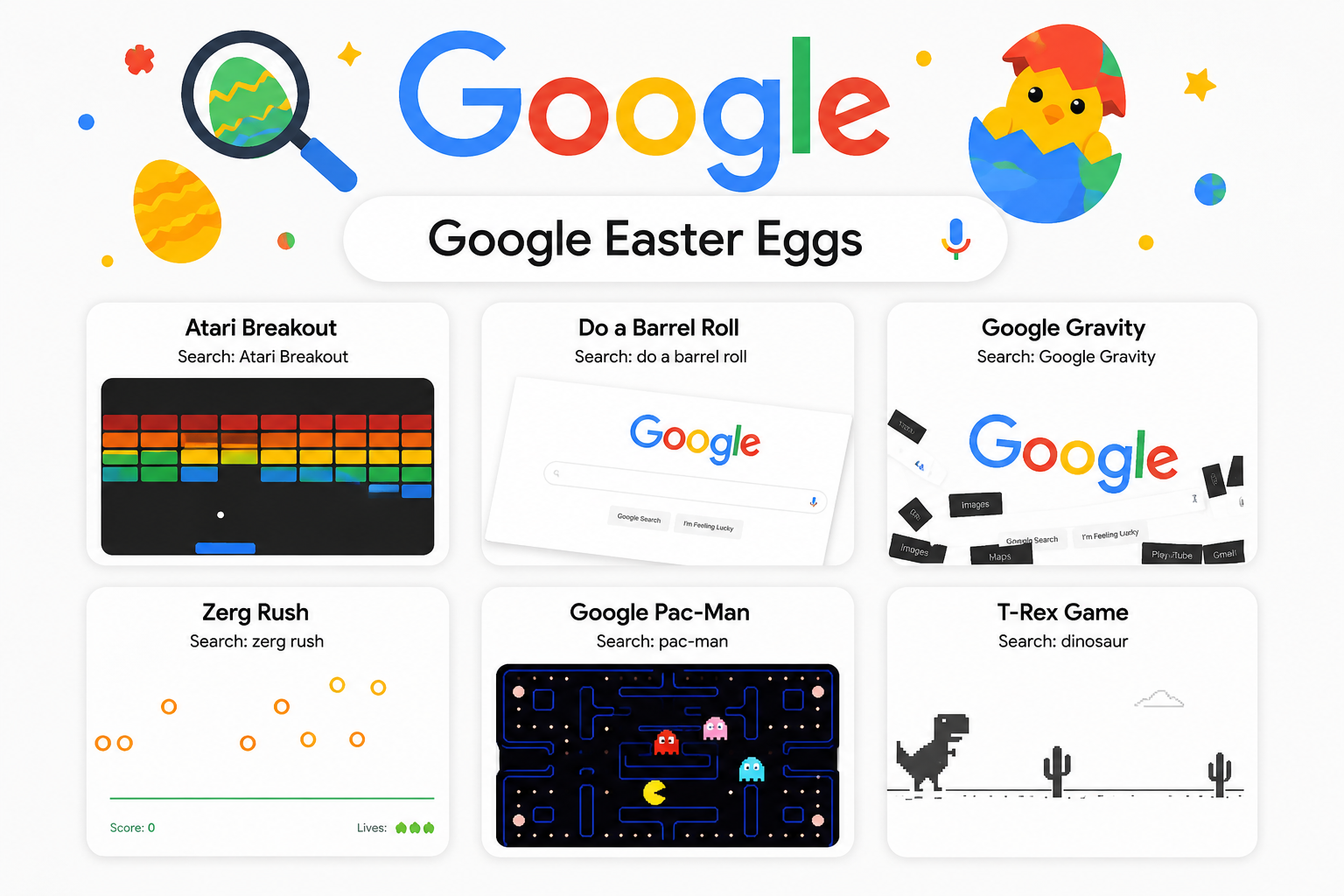
Google Easter Eggs are hidden features, playful animations, jokes, games, and surprises built into Google Search and other Google products. They are designed to entertain users while demonstrating the creativity and personality behind one of the world’s most widely used technology platforms. Unlike ordinary search results, an Easter egg can transform a simple query into an interactive experience. Some make the page move, some provide a game to play, while others display a humorous response to a particular search phrase. The fun comes from discovering these features naturally, often without any obvious indication that something special is waiting behind the search box.
What Are Google Easter Eggs?
Google Easter Eggs are hidden responses or interactive features triggered by specific searches, commands, or actions. Instead of simply showing conventional links and information, Google may respond with an animation, game, visual effect, joke, special calculator, or unusual search result.
Some Easter eggs are extremely simple. A search may cause the screen to rotate, produce a humorous message, or display a special animation. Others are much more elaborate, allowing users to interact with games directly inside the browser. This variety is one reason Google Easter Eggs have remained popular for so many years.
Why Does Google Create Easter Eggs?
Google Easter Eggs help give the company’s products a distinctive personality. Search is often viewed as a serious tool used for research, work, education, shopping, and everyday questions. Easter eggs introduce an element of curiosity and playfulness into that experience. They can encourage users to explore different searches simply to see what happens.
Another reason Easter eggs are valuable is that they reflect Google’s technology and engineering culture. Developers can use these features to experiment with animations, interactive elements, games, and creative interfaces. A small hidden feature may not have a major practical purpose, but it can demonstrate what is possible within a web browser.
How to Find Google Easter Eggs
Finding Google Easter Eggs is usually straightforward. Open Google Search and enter a known phrase associated with an Easter egg. If the feature is still supported, Google may automatically trigger the effect or provide an interactive element in the results. Some experiences require the user to click a button or interact with an object before the surprise begins.
The best part of searching for Easter eggs is experimentation. Try unusual phrases, references to popular culture, classic technology terms, games, and mathematical concepts. Google has historically hidden surprises across many categories, so users can discover them through curiosity as well as through dedicated lists of known Easter eggs.
Do Google Easter Eggs Still Work?
Not every Google Easter egg remains available forever. Some are removed because Google changes its search interface, updates browser technologies, retires older features, or decides that a temporary experience has served its purpose. Other Easter eggs continue to work for many years and become recognized classics.
This means that lists of Google Easter Eggs can sometimes contain outdated information. A search that once triggered an animation may now simply return ordinary results. Users should therefore understand that Easter eggs can be temporary. Google also occasionally brings back older experiences for special occasions, meaning an Easter egg that disappeared may sometimes return in another form.
Google Search Games
Some of the most memorable Google Easter Eggs are playable games. Google has created interactive experiences that allow people to enjoy games directly from the search page without installing traditional software. These games can be especially appealing when users want a quick distraction or when they are learning about a particular event or piece of technology.
One famous example is the dinosaur game associated with Google’s Chrome browser. When Chrome cannot connect to the internet, users may see a dinosaur on the error page. Pressing the appropriate key allows the dinosaur to run through a simple obstacle course. Although this feature is technically associated with Chrome rather than being a conventional Google Search Easter egg, it has become one of Google’s most recognizable hidden gaming experiences.
Google Doodle Easter Eggs
Google Doodles are another major part of Google’s playful culture. The Google logo is occasionally redesigned to celebrate important people, discoveries, holidays, historical events, cultural milestones, or notable occasions. Some Doodles are static images, while others are interactive games and experiences.
Interactive Doodles have become particularly popular because they can turn the Google homepage into a temporary game or educational activity. Users may be able to play music, solve puzzles, operate virtual objects, or participate in a themed challenge. These experiences are often available for a limited period, although Google maintains an archive of many previous Doodles.
Do a Barrel Roll
One of the classic Google Search Easter Eggs is associated with the phrase “do a barrel roll.” When supported, the search page performs a complete rotation, creating the impression that the entire screen is spinning. The trick became famous because it is unexpected and requires no special software or installation.
The phrase itself is a reference to a maneuver commonly associated with aviation and popular culture. Google’s implementation turned the phrase into a playful visual effect that quickly spread across the internet. It remains one of the most frequently mentioned examples whenever people discuss Google Easter Eggs.
Askew and Visual Search Tricks
Google has also experimented with Easter eggs that subtly change the appearance of the search page. Searching for certain terms can make the results page appear slightly tilted or altered. These effects are amusing because the user may initially wonder whether something has gone wrong with their browser.
Such Easter eggs demonstrate that Google can manipulate the presentation of its interface in response to a search query. They are usually simple but memorable, proving that an effective Easter egg does not necessarily need complicated gameplay or elaborate graphics.
The Google Calculator and Hidden Mathematical Fun
Google Search contains powerful mathematical capabilities that can feel like Easter eggs when users discover them through experimentation. Entering equations, mathematical expressions, unit conversions, and certain calculations can produce interactive tools directly within search results.
These features are useful as well as entertaining. A user can type a calculation instead of opening a separate calculator application, and Google can often interpret a wide variety of mathematical expressions. This demonstrates one of the central principles behind Google’s search experience: users can enter natural queries and receive specialized tools rather than simply a list of webpages.
How Developers Can Learn From Google Easter Eggs
Developers can learn several important lessons from Google’s approach to Easter eggs. First, hidden features should be easy to understand once discovered. Second, the interaction should feel rewarding rather than frustrating. Third, an Easter egg should complement the product rather than interfere with its main purpose.
Google also demonstrates how small creative details can generate significant attention. A developer does not necessarily need to build a massive application to create something memorable. A clever interaction can become popular if it is unexpected, easy to share, and connected to something users already understand.
The Future of Google Easter Eggs
The future of Google Easter Eggs will likely continue to involve interactive search features, games, animations, cultural references, and experiments with new web technologies. As search becomes more conversational and increasingly integrates artificial intelligence, Easter eggs may evolve beyond simple keyword-triggered animations.
Future hidden features could potentially respond more dynamically to user interactions, incorporate richer multimedia experiences, or appear within conversational search interfaces. The exact direction is difficult to predict, but the underlying purpose is likely to remain the same: creating moments of discovery and delight.
Final Thoughts
Google Easter Eggs represent one of the most entertaining traditions in modern internet culture. From spinning search pages and interactive games to special Doodles and clever references, these hidden features show how a powerful search platform can also be playful and creative. They encourage users to experiment, explore, and look beyond the ordinary search results page.
Not every Easter egg will remain available forever, and some features may change as Google updates its products. That uncertainty is part of the excitement. Whether you are a casual internet user, technology enthusiast, developer, gamer, or simply someone who enjoys discovering hidden details, exploring Google Easter Eggs offers an easy way to find a more playful side of the web.
Also Read Here: Bear Trap

1 thought on “Google Easter Eggs: Strange, Funny and Fascinating Search Secrets”