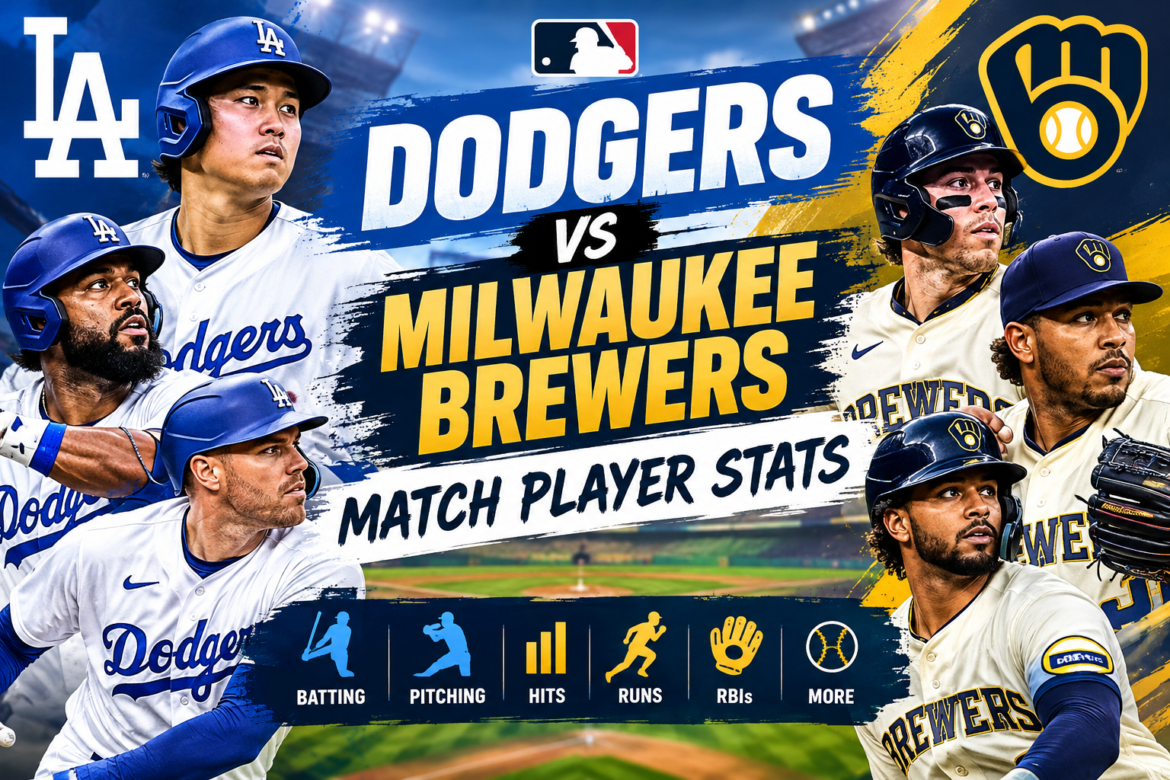
The Dodgers vs Milwaukee Brewers match player stats provide a detailed way to understand how individual performances shaped the 2026 meetings between these two National League teams. During the 2026 regular season, Los Angeles and Milwaukee faced each other multiple times, producing games that included strong pitching performances, home runs, timely hitting, defensive plays, and dramatic late-inning moments. Looking at individual statistics rather than only the final score gives a clearer picture of which players contributed through batting, pitching, base running, and defense.
Dodgers vs Brewers 2026 Head-to-Head Overview
The 2026 head-to-head schedule featured a three-game series at American Family Field in May followed by a four-game series at Dodger Stadium in August. The Dodgers won two of the three May games, including an 11-3 victory on May 23 and a 5-1 victory on May 24. Milwaukee then took three of four games in the August series, including victories on August 13, August 15, and August 16.
These results show why Dodgers vs Milwaukee Brewers match player stats can vary considerably from one game to another. A player who struggles in one matchup can produce a major performance in the next, while pitching matchups and bullpen usage can dramatically influence offensive numbers.
Teoscar Hernández’s Big Offensive Performance
One of the most notable individual performances in the 2026 Dodgers-Brewers meetings came from Teoscar Hernández on May 23. Hernández went 3-for-4 with two runs scored, six RBIs, one home run, one walk, and one strikeout. His six RBIs were particularly important because Los Angeles defeated Milwaukee 11-3 in that game. The performance demonstrated how one middle-of-the-order hitter can change the shape of a game when multiple runners reach base ahead of him.
Hernández’s home run was also part of an 11-hit Dodgers offensive attack. Rather than relying on one type of offensive production, Los Angeles combined hits, walks, extra-base production, and timely hitting to create a large advantage. His performance stands out in any review of Dodgers vs Milwaukee Brewers match player stats because the six-RBI total represented a substantial portion of the team’s scoring in that contest.
Freddie Freeman’s On-Base Impact
Freddie Freeman also produced an interesting statistical performance during the May 23 matchup. He recorded one hit and scored three runs while drawing four walks. Although his hit total was modest, his ability to reach base repeatedly created opportunities for teammates and allowed him to score three times.
Freeman’s performance is a useful example when examining the broader Dodgers vs Milwaukee Brewers match player stats. A hitter can make an important contribution without recording multiple hits or a home run. Reaching base, forcing pitchers to work, and moving into scoring position can be equally important components of offensive production.
Shohei Ohtani’s Contribution Against Milwaukee
Shohei Ohtani also appeared prominently in the Dodgers’ lineup during the 2026 meetings with Milwaukee. In the May 23 game, Ohtani went 2-for-5 with one RBI and one walk. He also struck out twice. His overall season numbers shown in that box score included a .276 batting average, .402 on-base percentage, .481 slugging percentage, and .882 OPS at the time of the game.
Ohtani’s value in these matchups extends beyond a single statistic because opposing pitchers must account for his ability to create extra-base damage while also controlling the strike zone. When reviewing Dodgers vs Milwaukee Brewers match player stats, his plate appearances are therefore useful for understanding how Milwaukee approached one of Los Angeles’ most prominent offensive threats.
Mookie Betts and the Importance of Context
Mookie Betts experienced a quieter offensive game in the May 23 matchup, going 0-for-6 with one strikeout. His six at-bats without a hit show why individual game statistics can sometimes look very different from a player’s broader reputation or season production. The same box score recorded six runners left on base for Betts, illustrating how opportunities do not always translate into hits or runs.
The lesson is important for anyone researching Dodgers vs Milwaukee Brewers match player stats. A single game should generally be viewed within the context of multiple matchups. Batting average, on-base percentage, slugging percentage, strikeout rate, home runs, and RBI totals become more informative when evaluated across a series rather than from one isolated performance.
Yoshinobu Yamamoto’s Pitching Role
Yoshinobu Yamamoto was another important name in the Dodgers-Brewers matchups. In the May 24 game, Milwaukee’s Sal Frelick produced an RBI fielder’s choice against Yamamoto, while the Brewers’ offense managed only one run in the game. Los Angeles ultimately won that contest 5-1.
Yamamoto’s role illustrates another important part of player statistics: pitching numbers must be evaluated differently from hitting numbers. Innings pitched, earned runs, strikeouts, walks, hits allowed, pitch count, and quality of contact all provide different information about a starter’s performance.
Roki Sasaki’s May 23 Performance
Roki Sasaki started for Los Angeles in the May 23 game and worked five innings, allowing two earned runs while recording four strikeouts and two walks. He threw 87 pitches in the outing. Despite Milwaukee scoring three early runs, the Dodgers’ offense responded with an 11-run performance, giving Sasaki the win.
Sasaki’s performance demonstrates why wins and losses do not always tell the complete story of a starting pitcher’s outing. His five innings, two earned runs, four strikeouts, and two walks provide a more detailed picture of his contribution. In a broader Dodgers vs Milwaukee Brewers match player stats analysis, those individual pitching categories can be compared with the offensive support a starter received.
Milwaukee Brewers’ Offensive Threats
Milwaukee’s lineup featured several important offensive players during the 2026 meetings, including Christian Yelich, Jackson Chourio, William Contreras, Garrett Mitchell, and other contributors. Pre-game analysis for the August 14 matchup highlighted Chourio’s projected batting ability, Contreras’ plate discipline and fly-ball profile, and Yelich’s strong projected offensive skill.
Chourio in particular was identified as a major part of Milwaukee’s lineup, while Contreras was noted for his combination of contact ability and plate discipline. When examining Brewers player statistics against Los Angeles, these types of offensive characteristics help explain why Milwaukee could remain dangerous even when facing a deep Dodgers pitching staff.
August Series Changed the Statistical Picture
The August series at Dodger Stadium produced a different statistical pattern from the May series. Los Angeles lost the opener 5-4, won the second game 3-1, then lost the final two games 4-1 and 6-2. StatMuse’s 2026 head-to-head data shows that the Dodgers scored only 10 runs across those four August games while collecting 23 hits.
The August 16 finale was particularly significant from a player-statistics perspective. Milwaukee collected 11 hits and six runs, while Los Angeles managed six hits and two runs. The Brewers also committed no errors in the game, while the Dodgers were charged with two.
Max Muncy’s Home Run Against Milwaukee
Max Muncy provided one of the notable moments in the August 16 game when he hit a solo home run in the fourth inning. The home run tied the game at 1-1 at that point, showing how quickly a single swing could change the scoreboard. Milwaukee eventually regained control and won 6-2.
Muncy’s home run is a good example of why individual player statistics should be connected to game situations. A home run can be important even when it does not ultimately determine the winner. Looking at the inning, score, runners on base, and opposing pitcher can provide additional context for understanding the importance of an individual offensive event.
Why Advanced Stats Matter in Dodgers vs Brewers Matchups
Traditional statistics such as hits, runs, home runs, RBIs, strikeouts, and batting average remain useful, but advanced statistics can provide additional context. Metrics such as OPS, wOBA, expected batting average, expected slugging percentage, exit velocity, barrel rate, and strikeout-to-walk ratio can help explain how a player is performing beneath the surface.
For example, pre-game analysis for the August 14 matchup examined expected statistics for players including Freddie Freeman, Mookie Betts, Kyle Tucker, William Contreras, Jackson Chourio, and Christian Yelich. Those measurements were projections and estimates rather than final game results, so they should not be confused with actual box-score statistics.
How to Read Dodgers vs Milwaukee Brewers Player Stats
When researching Dodgers vs Milwaukee Brewers match player stats, it is useful to separate batting, pitching, and fielding statistics. For hitters, at-bats, hits, runs, RBIs, walks, strikeouts, home runs, stolen bases, and OPS provide a basic statistical profile. For pitchers, innings, earned runs, hits allowed, walks, strikeouts, home runs allowed, and pitch count are important starting points.
It is also useful to compare individual performances with the team result. A player may have several hits in a losing effort, while another player may produce only one hit but drive in a decisive run. This is why a complete analysis should consider both raw numbers and game circumstances.
The Value of Series-Level Statistics
Series-level statistics can reveal patterns that are difficult to see from one game. Across the seven 2026 regular-season meetings listed by StatMuse, the Dodgers’ cumulative batting line against Milwaukee was .188/.291/.335, with 42 hits, seven home runs, 26 RBIs, and 27 runs. Those numbers include all seven listed games and therefore provide a broader view than any individual box score.
At the same time, the individual games demonstrate considerable variation. Los Angeles scored 11 runs in one May matchup but managed only one run in each of two August losses. This fluctuation illustrates how player availability, starting pitchers, bullpen matchups, ballpark conditions, defensive execution, and timely hitting can influence game-by-game results.
Dodgers vs Brewers Player Stats and Future Matchups
Player statistics from previous meetings can provide useful historical context, but they should not automatically be treated as predictions for future games. Rosters change, players move between teams, pitchers adjust their approaches, and current-season form can be different from previous performances.
For fans following future Dodgers-Brewers games, the most useful approach is to combine historical head-to-head numbers with current season statistics, confirmed lineups, starting pitchers, recent performance, and completed box scores.
Final Thoughts
Dodgers vs Milwaukee Brewers match player stats offer much more than a list of hits, runs, and strikeouts. The 2026 meetings showed how individual performances from players such as Teoscar Hernández, Freddie Freeman, Shohei Ohtani, Mookie Betts, Max Muncy, Yoshinobu Yamamoto, Roki Sasaki, Christian Yelich, Jackson Chourio, and William Contreras can influence the shape of a game.
Batting production, pitching efficiency, plate discipline, defensive execution, and situational hitting all contribute to the story. By combining individual box-score numbers with series-level statistics and current-season context, fans can get a clearer understanding of the performances behind every Dodgers vs Milwaukee Brewers matchup.
Also Read Here: TechNewsOutlets.com USA
1 thought on “Dodgers vs Milwaukee Brewers Match Player Stats: A Detailed Game Breakdown”