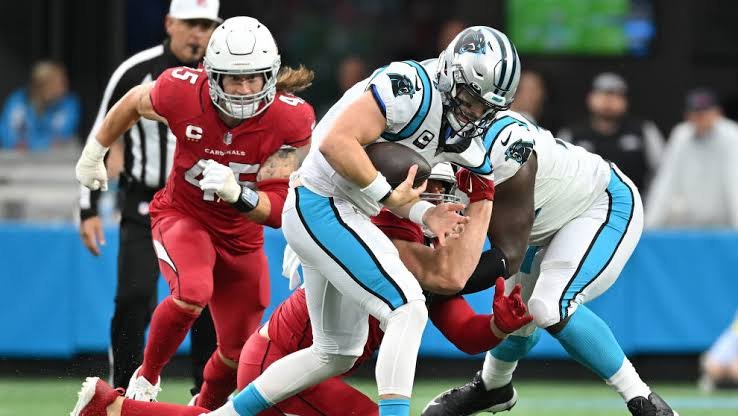
The arizona cardinals vs carolina panthers match player stats from the September 14, 2025 meeting show a game that changed dramatically as it progressed. The Arizona Cardinals defeated the Carolina Panthers 27–22 at State Farm Stadium, taking control early before Carolina produced a major fourth-quarter comeback attempt. Kyler Murray finished with 220 passing yards and one touchdown, while Bryce Young produced a career-high 328 passing yards and three touchdown passes.
The Final Score Does Not Tell the Whole Statistical Story
Arizona finished the game with 293 total yards compared with Carolina’s 352, meaning the Panthers actually gained 59 more yards. Carolina also ran 77 offensive plays compared with only 48 for Arizona. Yet the Cardinals won because their possessions were more productive, particularly during the first three quarters. The Panthers held the ball for 33:15, while Arizona had possession for 26:45.
The biggest difference came from turnovers and how those turnovers affected the scoreboard. Carolina lost possession twice through an interception and a fumble, while Arizona committed one interception. One of Carolina’s early mistakes became a defensive touchdown when Zaven Collins recovered a fumble and returned it three yards for a score.
The Cardinals then added field goals before extending their advantage with a late second-quarter touchdown. By halftime, Arizona led 20–3 even though Carolina had enough offensive production to suggest that the game was not necessarily going to remain one-sided.
Bryce Young’s 328 Passing Yards Stand Out
Bryce Young was one of the most statistically productive players in the matchup despite Carolina’s defeat. The Panthers quarterback completed 35 of 55 attempts for 328 yards, three touchdowns and one interception. His passer rating was 90.6, and he was sacked three times for 25 yards.
However, the distribution of those numbers is important. Young passed for only 111 yards and threw his interception in the first half. After halftime, he completed 24 of 38 attempts for 217 yards and three touchdowns. That huge difference explains why Carolina looked like a completely different offense during the final two quarters.
Young’s statistics therefore demonstrate both the strength and limitation of Carolina’s offensive performance. The raw passing yardage was excellent, but much of it came after Arizona had already established a substantial lead.
Kyler Murray Delivered More Efficient Passing
Kyler Murray’s numbers were less spectacular than Young’s in terms of yardage, but his passing efficiency helped Arizona create an early cushion. Murray completed 17 of 25 attempts for 220 yards, one touchdown and one interception. He also added 32 rushing yards on seven carries, giving him another dimension as a runner.
Murray’s 25 pass attempts compared with Young’s 55 attempts reveal an important difference in offensive game script. Arizona did not need to throw repeatedly after taking a 20–3 halftime lead. Carolina, on the other hand, had to keep throwing as it tried to erase a large deficit.
Murray’s rushing contribution also mattered. His seven carries produced 32 yards, including a 30-yard run. That long scramble was one of the plays that demonstrated how Arizona could gain yardage without relying exclusively on its passing attack. His mobility forced Carolina’s defense to account for the quarterback as an additional rushing threat.
Tetairoa McMillan Became Carolina’s Biggest Receiving Threat
Among the arizona cardinals vs carolina panthers match player stats, Tetairoa McMillan’s performance is particularly notable. The rookie wide receiver caught six passes for 100 yards on 10 targets, averaging 16.7 yards per reception. His longest catch covered 40 yards.
McMillan was not responsible for a touchdown, but his yardage production gave Carolina a major downfield option. His 100 receiving yards accounted for a substantial portion of Young’s 328 passing yards, and the 40-yard reception showed his ability to create significant gains from relatively few successful catches.
His target volume is also meaningful. Ten targets represented the largest target total among Carolina’s receivers in the game. That suggests the Panthers were willing to repeatedly use the rookie in their passing structure even while Arizona’s defense was attempting to limit explosive plays.
Hunter Renfrow Provided the Touchdowns Carolina Needed
Hunter Renfrow produced one of the most unusual receiving lines of the game. He caught seven passes for 48 yards and scored twice. His two touchdowns arrived during Carolina’s second-half comeback, making him a major factor in the Panthers’ late scoring surge.
Renfrow’s first touchdown came on a four-yard reception in the third quarter. His second came on a one-yard reception with 1:58 remaining in the fourth quarter. Those scores helped transform a 27–3 deficit into a 27–22 game. His 48 yards were not especially large compared with McMillan’s 100, but touchdowns change the meaning of receiving statistics.
Renfrow became one of Young’s most important red-zone targets because his receptions directly translated into points. The Panthers’ official review also noted that the two-touchdown performance was Renfrow’s first multi-touchdown game since the 2021 season.
Trey McBride Led Arizona’s Receiving Production
For Arizona, tight end Trey McBride was the leading receiver. He finished with six receptions for 78 yards on seven targets, averaging 13 yards per catch. His longest reception went for 31 yards. McBride’s role was important because Arizona did not need an enormous number of completions to move the ball effectively.
His seven targets also indicate strong involvement within Arizona’s passing game. Even without a touchdown, McBride consistently helped generate first downs and meaningful gains. His 31-yard reception was particularly valuable because it demonstrated that Arizona’s passing attack could produce explosive plays without requiring a large volume of attempts.
Elijah Higgins also contributed two catches for 45 yards, while Trey Benson added four receptions for 30 yards. Marvin Harrison Jr. caught two passes for 27 yards, and Michael Wilson had the most important Arizona receiving play of the game: an 11-yard touchdown reception just four seconds before halftime.
James Conner Supplied Arizona’s Ground Game
James Conner carried the ball 11 times for 34 yards and scored Arizona’s third-quarter rushing touchdown. His average was 3.1 yards per carry, so the rushing numbers were not particularly explosive on a per-attempt basis.
Yet the context matters more than the average alone. Conner’s two-yard touchdown run completed a 71-yard Cardinals drive and pushed the score to 27–3. That touchdown extended Arizona’s advantage at a time when Carolina desperately needed to prevent the game from becoming even more difficult to recover.
Arizona finished with 82 rushing yards compared with Carolina’s 49. Murray contributed 32 yards, while Trey Benson added 14 yards on three attempts. The Cardinals therefore received meaningful production from multiple rushing sources rather than depending entirely on Conner.
Chuba Hubbard Was More Valuable as a Receiver Than Runner
Hubbard’s rushing numbers were modest, but his receiving contribution was more significant. He caught five passes for 39 yards and a touchdown, giving him 77 total yards from scrimmage. His receiving touchdown came in the fourth quarter during Carolina’s comeback.
That distinction helps explain how Carolina accumulated offensive yardage despite its poor rushing average. The Panthers were not consistently moving the football on the ground, so Young relied heavily on short and intermediate passing opportunities to running backs and other skill-position players.
Hubbard’s six targets were also evidence of his importance within the passing game. His receiving touchdown cut Arizona’s advantage to 27–15, keeping Carolina within reach before Renfrow’s late touchdown made the contest even tighter.
Arizona’s Defense Created the Difference Early
The defensive statistics provide perhaps the clearest explanation for Arizona’s victory. Carolina gained 352 yards and recorded 26 first downs, compared with Arizona’s 293 yards and 16 first downs. Those numbers might initially suggest that the Panthers controlled the game offensively.
Josh Sweat forced the fumble that Zaven Collins returned for a touchdown. Baron Browning intercepted Young, giving Arizona another takeaway. Calais Campbell then finished with two sacks, including the decisive sack on Carolina’s final possession.
Jalen Thompson led the Cardinals with 10 total tackles, while Budda Baker and Mack Wilson Sr. each recorded eight. Garrett Williams added seven tackles. The defensive production was spread across the unit rather than coming from only one player.
Calais Campbell’s Two Sacks Became Game-Defining Plays
Campbell’s defensive statistics deserve special attention because his two sacks were not merely routine box-score entries. One of them came during Carolina’s final drive when the Panthers still had an opportunity to complete their comeback.
With Carolina threatening late, Campbell brought Young down on fourth down, ending the Panthers’ final attempt to move into scoring range. The sack preserved Arizona’s five-point lead and effectively ended the contest. Campbell finished with five total tackles, two sacks and two tackles for loss.
This is a useful reminder that defensive statistics need to be viewed in context. A sack early in a game can create a favorable down-and-distance situation. A sack on fourth down during the final possession can directly determine the result.
What the Player Statistics Reveal About Both Teams
The arizona cardinals vs carolina panthers match player stats reveal two very different paths through the same game. Arizona’s key contributors produced efficient, high-impact plays. Murray passed for 220 yards, Conner scored on the ground, McBride moved the chains, Wilson caught the crucial touchdown, and the defense generated turnovers and late pressure.
Carolina’s production was much more volume-driven. Young attempted 55 passes, McMillan surpassed 100 receiving yards, Sanders caught seven passes, Renfrow scored twice, and Hubbard contributed as both a runner and receiver. Yet Carolina’s offense needed that enormous volume because it spent much of the game trying to recover from an early deficit.
How the 2025 Game Compares With the Previous Meeting
The matchup becomes even more interesting when the 2025 game is compared with the previous regular-season meeting between these teams. On December 22, 2024, Carolina defeated Arizona 36–30 in overtime at Bank of America Stadium. Chuba Hubbard rushed for 152 yards and two touchdowns on 25 carries, while Bryce Young threw for 158 yards and two touchdowns and added 68 rushing yards.
That 2024 game and the 2025 meeting were dramatically different statistically. In 2024, Carolina’s running game was the central story. In 2025, the Panthers gained only 49 rushing yards and relied overwhelmingly on Young’s passing arm. Arizona also reversed the outcome, winning 27–22 after losing the previous meeting 36–30.
Why the Numbers Matter for Understanding the Matchup
Looking only at the biggest yardage totals would make Carolina’s performance appear stronger than Arizona’s. The Panthers had more total yards, more first downs, more plays and more time of possession. But Arizona scored 27 points from a much smaller number of offensive plays and forced the turnovers that shaped the first half.
For Carolina, the numbers demonstrate genuine offensive improvement during the game, particularly through Young’s passing and McMillan’s receiving production. For Arizona, the statistics highlight defensive impact and early scoring efficiency. Neither story is fully captured by the final 27–22 score.
Final Takeaway From the Player Stats
The arizona cardinals vs carolina panthers match player stats from September 14, 2025 describe a game of contrasting halves. Arizona controlled the opening stages, capitalized on turnovers, and built a 27–3 advantage. Carolina then produced 19 unanswered points, with Bryce Young throwing for a career-high 328 yards and three touchdowns while Tetairoa McMillan reached 100 receiving yards and Hunter Renfrow scored twice.
Arizona’s most important numbers came from different areas: Kyler Murray’s 220 passing yards, James Conner’s rushing touchdown, Trey McBride’s 78 receiving yards, Zaven Collins’ defensive touchdown, and Calais Campbell’s two sacks. Campbell’s final sack was particularly important because it stopped Carolina’s last attempt to complete the comeback.
Also Read Here: Green Bay Packers vs Detroit Lions match player stats



1 thought on “Arizona Cardinals vs Carolina Panthers Match Player Stats: Complete NFL Breakdown”