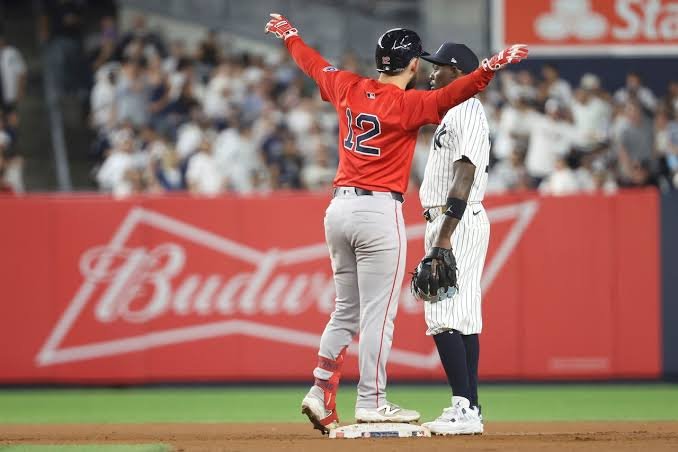
The search intent behind red sox vs new york yankees match player stats is primarily to find the latest player-level numbers, starting-pitcher matchups, offensive leaders, recent head-to-head context, and the players most likely to influence the game. As of September 29, 2026, the matchup has become an American League Wild Card Series between Boston and New York, with Game 1 scheduled for September 29 at Yankee Stadium. Boston is starting Payton Tolle, while New York is scheduled to counter with Cam Schlittler.
Why the 2026 Red Sox-Yankees matchup is different from a normal regular-season game
This meeting is not simply another entry in the historic rivalry. Boston and New York enter the postseason as the No. 5 and No. 4 American League Wild Card teams, respectively, with the entire best-of-three series taking place at Yankee Stadium. The Yankees finished the regular season 93-68, while Boston finished 87-75, giving New York home-field advantage.
The pitching matchup also immediately puts the spotlight on two of the most productive starters in this series. Boston’s Payton Tolle completed the regular season with a 3.03 ERA, 171 strikeouts and 148⅔ innings, while New York’s Cam Schlittler finished with a remarkable 1.95 ERA, 228 strikeouts and a 0.90 WHIP over 184⅔ innings.
Payton Tolle vs Cam Schlittler creates the first major statistical battle
Tolle’s 2026 season has been one of the most important developments in Boston’s pitching staff. His 171 strikeouts in 148⅔ innings illustrate why the Red Sox are comfortable putting him on the mound for Game 1 of a postseason series against the Yankees. His 3.03 ERA and 1.10 WHIP also show that his effectiveness has not depended solely on strikeouts.
The contrast is useful when interpreting the red sox vs new york yankees match player stats. Tolle offers Boston a high-strikeout left-handed starter, while Schlittler combines strikeout production with exceptional run prevention. The first few innings could therefore revolve around whether Boston’s left-handed hitters can extend at-bats and whether New York’s lineup can generate enough traffic against Tolle.
Ben Rice has emerged as one of New York’s biggest offensive statistical stories
Among the Yankees’ hitters, Ben Rice stands out because of his combination of power, on-base production and durability. MLB’s latest 2026 regular-season figures show Rice with 151 hits, 41 home runs, 97 RBIs, a .264 batting average, .363 on-base percentage and .897 OPS.
Rice reached the 40-home-run mark on September 23, when he hit two homers against Tampa Bay. The performance put him at 40 and 41 home runs and tied him for the American League lead at that point.
Those numbers make Rice particularly relevant against Boston’s pitching. A player with 41 home runs has the ability to change the game with one swing, but his .363 OBP also means pitchers cannot simply focus on avoiding extra-base hits. If Tolle or Boston’s relievers leave pitches over the heart of the zone, Rice has demonstrated the power to punish mistakes.
Aaron Judge’s statistics need to be viewed through the injury context
Aaron Judge remains one of the most recognizable names in the Yankees lineup, but his 2026 statistical line is unusual compared with his typical full-season production. He appeared in only 66 games and finished with a .241 average, .360 OBP, .511 slugging percentage, 18 home runs and 41 RBIs.
Judge missed substantial time with a right rib fracture before returning in September, and he subsequently suffered a right calf strain. His availability for the opening Wild Card game remained uncertain as of September 29.
That uncertainty is important when readers look at Yankees player statistics. Judge’s .871 OPS over his 66 games indicates that he remained productive when available, but his limited sample cannot simply be treated like the statistics of a player who completed a normal 162-game season.
Cody Bellinger gives the Yankees another reliable offensive option
Cody Bellinger enters the postseason with a different statistical profile from Rice. MLB’s latest figures show Bellinger with 131 hits, 17 home runs, 73 RBIs and a .266 batting average across 131 games. His .341 OBP and .774 OPS provide additional offensive value behind New York’s other major threats.
Bellinger’s importance goes beyond his home-run total. His 25 doubles were among the Yankees’ leading extra-base totals, giving New York another way to create scoring opportunities without depending exclusively on the long ball.
Against a Boston pitching staff that has emphasized run prevention, getting extra-base hits from players such as Bellinger can become especially significant. A double can place a runner in scoring position without requiring multiple singles, reducing the number of opportunities needed to manufacture a run.
Jazz Chisholm Jr. adds speed and another dimension to the Yankees lineup
Jazz Chisholm Jr. finished the regular season with 109 hits, 19 home runs, 55 RBIs and 41 stolen bases according to MLB’s latest statistics. His .231 batting average and .312 OBP are less important to understanding his role than the combination of power and baserunning he provides.
The 41 stolen bases give Chisholm a particularly different offensive profile from Rice or Bellinger. If he reaches base, the Yankees can potentially create pressure without needing an extra-base hit. His speed can also influence how Boston positions its infield and how quickly pitchers deliver to the plate.
Chisholm had recently returned from a right thumb injury, making his exact role another important lineup consideration. Reports before Game 1 indicated that the Yankees were weighing their second-base options against left-handed starter Payton Tolle.
Roman Anthony has become an important part of Boston’s offensive picture
For Boston, Roman Anthony is one of the most interesting players to examine in current red sox vs new york yankees match player stats discussions. In September through the latest available Red Sox statistics, Anthony had 23 hits, four home runs, 10 RBIs and a .242 batting average across 95 at-bats. His September OPS was .733.
Anthony also produced a major performance during Boston’s September 25 victory over the Chicago Cubs. He went 3-for-3, scored three runs and delivered a seventh-inning triple that helped initiate the winning rally.
That recent performance illustrates why postseason analysis cannot rely exclusively on season-long totals. A player entering a series with recent quality at-bats can become an important part of the lineup even when his overall numbers do not dominate the statistical leaderboard.
Trevor Story brings recent offensive production to Boston’s lineup
Trevor Story has also produced useful numbers for Boston late in the season. Through the latest September data available, Story had 21 hits in 78 at-bats, including five doubles and two home runs, while batting .269 with a .305 OBP and .715 OPS during that period.
His recent production gives Boston another experienced hitter who can contribute in multiple ways. Story does not need to produce a home run to influence a game; doubles, baserunning and situational contact can all matter when facing a pitcher such as Schlittler.
His matchup with New York’s pitching is particularly interesting because the Yankees’ staff has been one of the defining strengths of the team. Boston’s hitters may need to avoid chasing pitches outside the strike zone and force Schlittler to work through extended plate appearances.
Max Fried and Gerrit Cole strengthen New York’s pitching depth
New York has considerable pitching depth behind Schlittler. Max Fried finished the regular season with a 2.63 ERA and 1.00 WHIP over 106 innings, while Gerrit Cole posted a 3.67 ERA and 1.13 WHIP across 115⅓ innings. Fried’s ability to limit baserunners is particularly notable.
His .198 opponent batting average was among the strongest marks on the Yankees’ pitching staff, while his four home runs allowed across 106 innings illustrate his effectiveness at limiting major damage. Cole’s numbers are less dominant than Schlittler’s but still represent a substantial postseason resource.
What the player statistics suggest about the offensive matchup
The Yankees’ statistical profile is heavily influenced by power from Rice and contributions from Bellinger, Judge when available, Goldschmidt and other complementary hitters. Rice’s 41 home runs lead the team’s current offensive story, while Chisholm’s 41 stolen bases provide a completely different method of creating pressure.
Boston’s recent offensive numbers point toward a more varied approach. Anthony, Story, Rutschman and Abreu have all provided stretches of production, but the Red Sox have also experienced a late-season scoring slowdown. One recent analysis noted that Boston had not scored six or more runs in its previous 21 games entering the Wild Card Series.
That makes early baserunners especially important for Boston. Against a starter with Schlittler’s strikeout ability, waiting for a series of consecutive hits may not be realistic. Quality at-bats, walks and extra-base hits can therefore carry substantial value.
Bullpen performance could decide the later innings
Starting-pitcher statistics naturally receive most of the attention, but bullpen performance can determine whether a strong start becomes a win. Boston entered the postseason with a pitching staff that had been among the league’s strongest by several advanced measures, while Aroldis Chapman had recorded 35 saves according to postseason preview reporting.
This creates an important strategic battle. If either starter exits after five or six innings with a narrow lead, the opposing lineup may face several different pitching styles before the game ends. In a short postseason series, managers can use their best relievers more aggressively than they typically would during the regular season.
Which statistics matter most when following Red Sox vs Yankees player performance
For hitters, batting average remains useful for describing contact success, but OPS, OBP, slugging percentage, home runs, RBIs, strikeout rate and recent performance provide a broader picture. For pitchers, ERA and WHIP are helpful starting points, while strikeouts, walks, innings and opponent batting average add important context.
The same principle applies to Boston. Tolle’s 171 strikeouts, 3.03 ERA and 1.10 WHIP describe a pitcher whose value comes from both swing-and-miss ability and run prevention. Gray’s 2.72 ERA and 149 strikeouts provide additional evidence of Boston’s rotation depth.
How to read the final Red Sox vs Yankees match player stats
Once the game is completed, the most useful box-score information will include each hitter’s at-bats, hits, runs, RBIs, home runs, walks and strikeouts, along with the starting pitchers’ innings, hits allowed, earned runs, walks and strikeouts. Those figures will reveal who actually influenced the result rather than who entered the game with the strongest season-long reputation.
For a postseason matchup like this, however, the box score should be read alongside the game situation. A two-run single with two outs can have a very different impact from a hit in a low-leverage inning, while a pitcher who allows one run over six innings can influence the game differently from a reliever who records three critical outs with the tying run on base.
Conclusion
The Red Sox vs new york yankees match player stats show just how closely matched and statistically interesting this postseason rivalry has become. New York enters the Wild Card Series with major offensive power from players such as Ben Rice, Cody Bellinger, and if available, Aaron Judge, while Boston brings a pitching staff led by Payton Tolle and supported by experienced arms such as Sonny Gray.
Ultimately, the most important numbers will come from the players who perform in the highest-leverage moments. Following the individual player statistics alongside the final score provides a much clearer picture of how the Red Sox and Yankees actually controlled each game and why the series developed the way it did.
Also Read Here: knicks vs san antonio spurs match player stats


1 thought on “Red Sox vs New York Yankees Match Player Stats: Latest Player Breakdown”