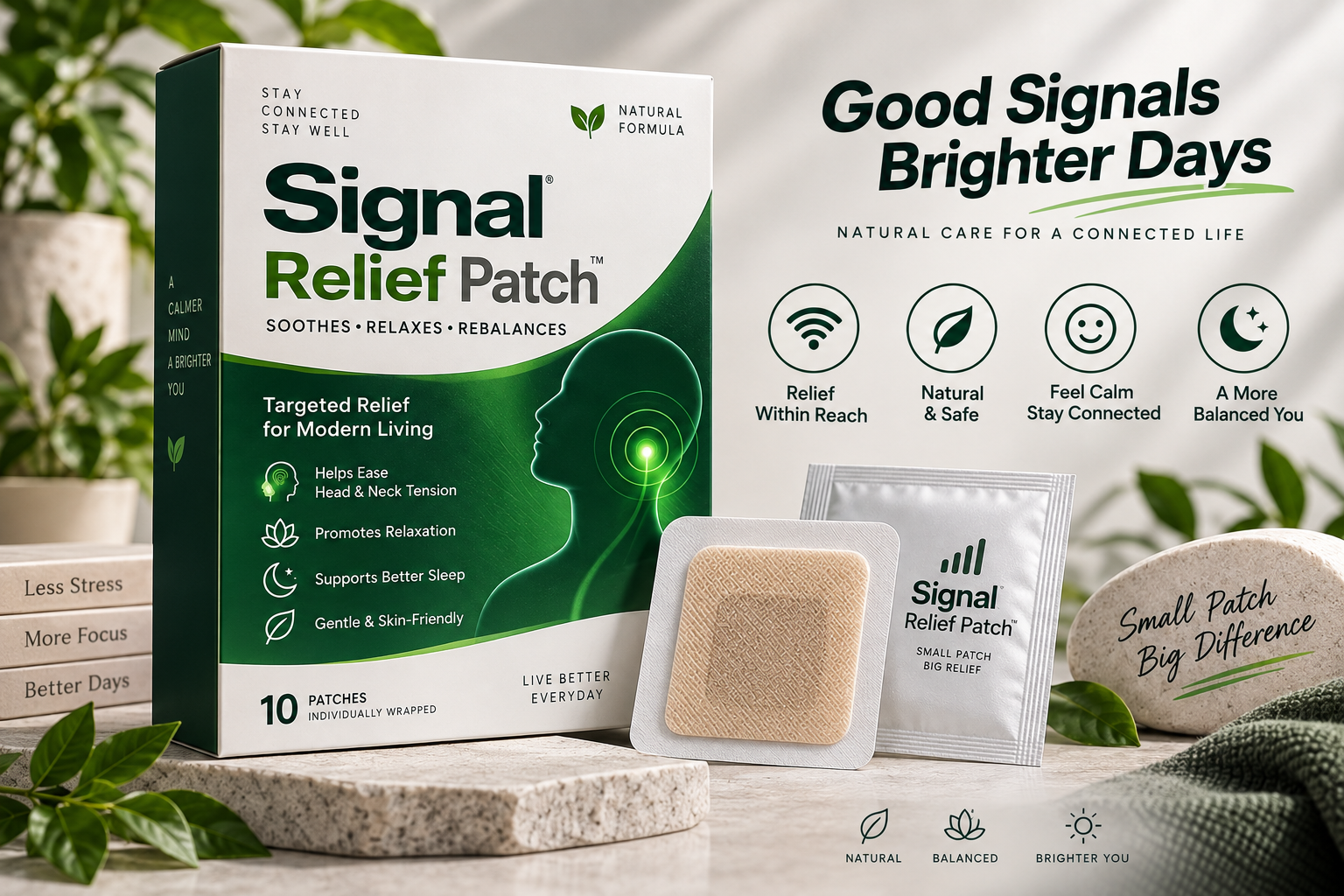
The Signal Relief Patch is a reusable, drug-free wearable product designed to support relief from musculoskeletal discomfort. It contains no drugs, wires, or batteries, and its technology uses passive nano-capacitor components; however, the available clinical evidence is still developing, so it should not be presented as a proven treatment for every type of pain.
What Is the Signal Relief Patch?
The Signal Relief Patch is a thin, flexible patch intended to be placed over or near an area of discomfort. According to the publicly registered clinical study, the patch contains no drugs, wires, or batteries. Its developers describe the technology as using nano-capacitors that interact with the body’s electrical system. The exact mechanism by which the technology may influence pain perception remains under investigation.
The product is marketed as a non-invasive alternative for people who want a drug-free approach to managing everyday discomfort. The manufacturer says it can be used for areas such as the back, shoulders, hips, and other larger areas of discomfort.
How Does the Signal Relief Patch Work?
Unlike a conventional electronic pain-relief device, the Signal Relief Patch does not require charging or an external power source. ClinicalTrials.gov describes it as a passive device containing nano-capacitors. The underlying mechanism is still being studied rather than being established as a universally accepted explanation for pain relief.
This distinction is important. A product can have encouraging research findings without scientists having completely established why it produces the reported effect. Signal Relief itself acknowledges that larger and more extensive research is needed to better understand what happens at the skin, nerve, and brain levels.
What Does Research Say About the Signal Relief Patch?
Some clinical research is worth examining. A pilot study registered on ClinicalTrials.gov investigated the patch in adults with chronic musculoskeletal pain. The completed study enrolled 44 participants and instructed them to use the patch daily for seven days. It was an interventional, single-group, open-label study rather than a randomized placebo-controlled trial.
More recently, a company-reported study involving 112 adults with chronic back or knee pain used a double-blind, placebo-controlled design. Signal Relief reports that participants using the active patch experienced an average 42% reduction in pain, compared with 34% in the placebo group. It also reports that 71% of participants felt relief within 15 minutes and 98% experienced relief at some point within 72 hours.
Is There Peer-Reviewed Evidence?
A 2025 case report published in Pain Medicine Case Reports described a 75-year-old man with more than 35 years of chronic low-back pain associated with an L2-L3 disc herniation. The report stated that daily use of the nCAP Signal Relief Patch was associated with reported 90% to 100% back pain relief and functional improvement over three months.
However, this was a single-patient case report, not a large randomized clinical trial. Case reports can provide useful observations and generate hypotheses, but they cannot establish that the same results will occur in a broader population.
What Conditions Is It Intended For?
Signal Relief focuses primarily on musculoskeletal discomfort. The manufacturer describes the patch as suitable for areas including the back, shoulder, and hip. The registered clinical research specifically examined musculoskeletal pain.
Importantly, ClinicalTrials.gov lists exclusions including acute injuries requiring rapid treatment and people using certain prescription pain medications during the study. The patch should therefore not be viewed as a substitute for diagnosis or treatment of an underlying medical condition.
How Is the Patch Used?
The manufacturer’s instructions recommend identifying the main source of discomfort and positioning the patch on or slightly above that area. It can be secured with the supplied latex-free adhesive or positioned inside close-fitting clothing.
The manufacturer describes the patch as reusable and says it is designed to last for at least one year with proper care. It also currently advertises a 45-day money-back guarantee.
Individual results can vary, so users should pay attention to how their own body responds rather than assuming that advertised study results guarantee a particular outcome.
Safety and Important Precautions
The available ClinicalTrials.gov record identifies the studied product as an FDA-regulated device that was not approved or cleared by the FDA at the time of that study record.
Signal Relief’s current safety guidance advises people with diabetes, circulation problems, chronic pain, skin conditions, nerve disorders, implantable devices, or other medical conditions to consult a healthcare professional before use. Its current guidance also says not to use the product during pregnancy.
People with pacemakers, implantable defibrillators, implantable pain-management devices, or other neuromodulation implants should be particularly cautious and consult their physician before considering use.
Is the Signal Relief Patch a Cure for Pain?
No. It is more accurate to describe it as a drug-free product intended to support comfort rather than a cure for an underlying disease or injury.
Pain can have many causes, including injuries, nerve problems, inflammation, joint conditions, and other medical issues. Reducing the sensation of pain does not necessarily address its underlying cause. Anyone experiencing persistent or worsening symptoms should speak with an appropriate healthcare professional.
What Makes the Product Interesting?
The main appeal is its combination of a non-drug design and reusable format. Unlike medication-based approaches, the patch does not contain an active pharmaceutical ingredient, and unlike powered electronic devices, it does not require batteries or charging. Clinical research has also produced enough early findings to justify continued investigation.
At the same time, consumers should separate manufacturer claims, preliminary studies, case reports, and stronger controlled evidence. That distinction is particularly important when evaluating products intended for pain.
Conclusion
The Signal Relief Patch is an unusual drug-free, reusable product that has attracted attention because of its passive nano-capacitor technology and reported pain-relief results. Clinical research, including a registered pilot study and later company-reported controlled research, provides encouraging signals, while a 2025 published case report offers another example of reported benefit.
Still, the evidence should be viewed realistically. The technology is not a guaranteed solution, and larger independent research would help establish how effective it is across different types of pain and different groups of people.
FAQs
What is the Signal Relief Patch?
It is a reusable, drug-free wearable patch designed to support comfort from musculoskeletal discomfort.
Does the Signal Relief Patch use batteries?
No. ClinicalTrials.gov describes it as containing no drugs, wires, or batteries.
How quickly can it work?
Company-reported research says some participants experienced relief within 15 minutes, although individual results vary.
Is the Signal Relief Patch FDA approved?
The ClinicalTrials.gov record for the registered pilot study identifies the studied device as not approved or cleared by the FDA.
Also Read Here: SparkPressFusion Com



1 thought on “Signal Relief Patch: Why This Simple Product Has People Asking Questions”