Table of Contents
ToggleWhat Is Target Company URL Research?
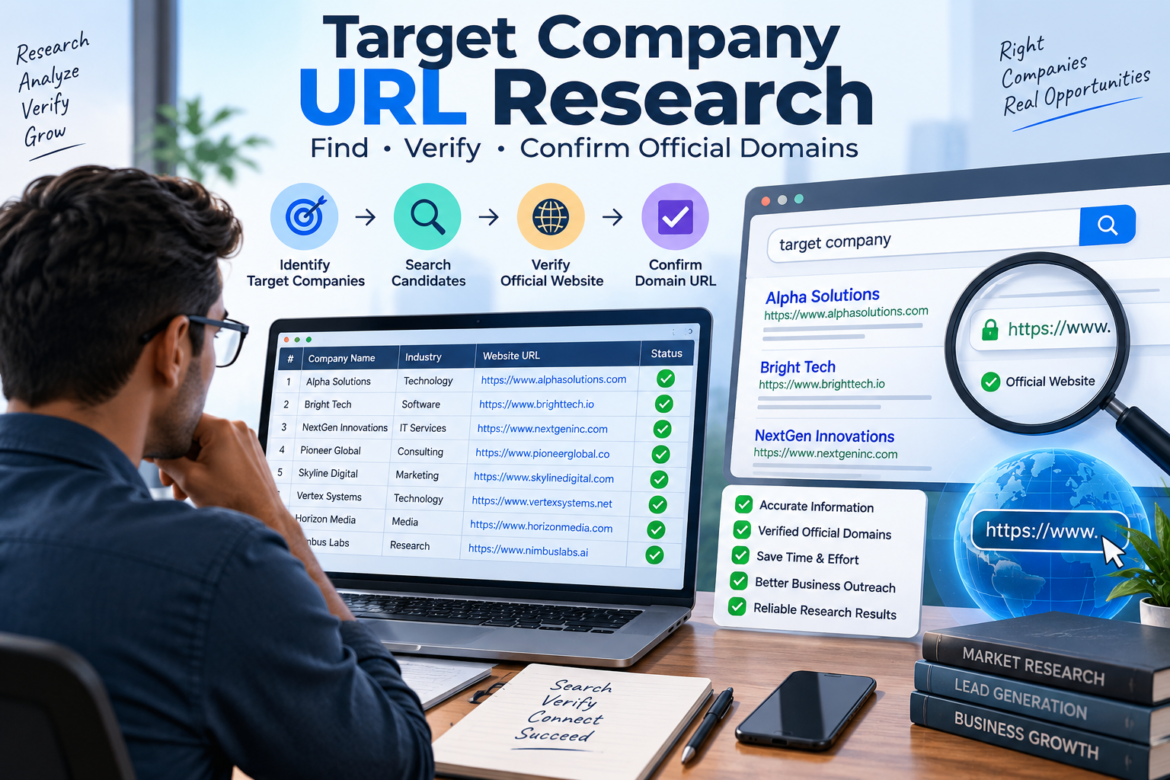
Target company URL research is the process of finding, identifying, and verifying the official website of a business you want to study, contact, analyze, or add to a business database. In practical terms, target company URL research turns a simple company name into a reliable website domain that can be used for further research, sales prospecting, recruitment, SEO analysis, market research, and business development.
Why Target Company URL Research Matters
A company name is not always a unique identifier. Several businesses can operate under similar names in different countries or industries, while some companies use a brand name that is completely different from their legal business name. Search engines may also display social media profiles, business directories, review websites, news articles, and third-party databases alongside the official website.
Because of this, choosing the first result without checking it can introduce incorrect information into a CRM or research spreadsheet. Reliable target company URL research adds an important verification step before the domain is accepted as the correct company website.
How Company Names Become Website Domains
The basic process begins with a list of company names. A researcher then searches for possible websites associated with each name and compares the results against available business information. The objective is not simply to find a domain containing the company name. Instead, the researcher needs to determine whether the website actually represents the intended organization.
Company branding, products, services, location, contact information, and About pages can all help confirm the relationship. This makes target company URL research more valuable than simply copying URLs from search results because the final objective is accuracy rather than speed alone.
The Difference Between a Website and an Official Company URL
A website can contain information about a company without being owned or operated by that company. For example, a business directory may have a detailed profile, but the directory is not the company’s official website. The same applies to social networks, review platforms, news publications, marketplace listings, and business databases.
An official company URL normally represents the organization’s primary web presence and provides first-party information about its products, services, team, locations, policies, or operations. Researchers should therefore distinguish between a website that mentions a company and a website that belongs to the company.
Why Similar Company Names Create Problems
One of the biggest challenges in target company URL research is dealing with businesses that have similar names. A generic name such as “Summit Solutions,” “Global Tech,” or “Prime Services” could belong to numerous organizations. Searching the name alone may produce several plausible domains.
The correct choice may depend on the company’s country, industry, city, product category, or other information contained in the original research list. A domain that looks convincing can still be wrong, which is why researchers should compare several pieces of evidence before approving a result.
The Role of Location in URL Verification
Location can be extremely useful when two or more companies share the same name. If a research list identifies a business as being located in London, Karachi, Dubai, New York, or another specific market, that information can be compared with the address shown on the company’s website.
Contact pages, About pages, legal notices, and footer information may provide useful clues. Location should not always be treated as conclusive evidence because companies can have multiple offices, but it can significantly improve the quality of a company-domain match.
Using Search Engines for Target Company URL Research
Search engines remain one of the simplest ways to begin company URL research. Entering the company name along with additional identifying information can narrow the results. Researchers can add a location, industry, product, or other known detail to make the search more specific.
However, search engines should be treated as a discovery tool rather than automatic proof that the first result is correct. Search results can include directories and unrelated organizations, so the selected website should be opened and verified before being recorded as the official domain.
Using Automated URL Research Tools
When working with a large company list, manual searching can become inefficient. Automated URL research tools can process multiple company names and return possible domains, which allows researchers to focus their time on reviewing uncertain matches.
Some tools also provide match or confidence scores, alternative candidates, and CSV export options. These features can be particularly useful for sales teams, recruiting teams, and researchers who regularly work with spreadsheets containing dozens or hundreds of businesses.
Why Match Scores Can Be Useful
A match score can provide a quick indication of how closely a returned company corresponds to the original search term. A high-confidence result may require only a quick verification, while a low-confidence result can be placed into a manual review queue. Match scores should not be treated as absolute proof, however.
Automated systems can make mistakes, especially when company names are common, abbreviated, translated, or associated with multiple organizations. The strongest workflow uses automated matching for efficiency and human verification for ambiguous cases.
Cleaning Company Names Before Research
Good target company URL research often begins with clean input data. Company lists may contain legal suffixes such as Inc., Ltd., LLC, GmbH, PLC, or other corporate designations. They may also contain duplicate names, unnecessary punctuation, extra spaces, or inconsistent capitalization.
Cleaning and standardizing these names before searching can improve matching and reduce duplicate results. Some URL lookup systems specifically remove duplicates and legal suffixes to make company-name matching more effective.
Target Company URL Research for Sales Teams
Sales professionals can use verified company domains to build stronger prospecting lists. Once the official website is identified, a salesperson can study the company’s products, services, customer segments, locations, recent announcements, and business priorities.
This information can help create more relevant outreach instead of sending the same generic message to every prospect. Accurate domains also make it easier to connect company records with other business intelligence and enrichment systems.
Target Company URL Research for SEO
SEO professionals can benefit significantly from accurate company-domain research. Competitor websites can be used as starting points for keyword research, content analysis, backlink research, and competitive comparisons. If a researcher accidentally selects the wrong domain, the resulting keyword and backlink data may be completely irrelevant.
This is why URL verification should happen before importing competitor domains into SEO platforms or building a competitor analysis report. Accurate domain identification creates a stronger foundation for every SEO research task that follows.
Handling Subsidiaries and Parent Companies
A company may belong to a larger corporate group and therefore have more than one relevant domain. A subsidiary could maintain its own website, while the parent organization operates a separate corporate website. In other cases, a brand may be integrated into the parent company’s domain.
Researchers should decide what they actually need before recording a URL. If the objective is researching the specific subsidiary, its own official domain may be more useful. If the objective is understanding ownership, the parent company’s corporate website may also need to be recorded.
What Happens When a Company Rebrands?
Rebranding can make URL research more difficult because a company may change its name and domain while old pages remain indexed by search engines. Sometimes the previous domain redirects to the new website, which provides a useful clue. In other cases, the old domain may still exist without representing the current company.
Researchers should therefore check whether the business has announced a name change, acquisition, merger, or domain migration before accepting an older URL as current. Keeping notes about former domains can also be useful when maintaining historical business databases.
A Practical Target Company URL Research Workflow
A reliable workflow can begin by collecting the original company list and cleaning the names. The next step is finding possible domains using search engines, company databases, or automated lookup tools. After candidate URLs are identified, researchers should compare company names, industries, locations, branding, products, and contact information.
High-confidence results can be approved, while ambiguous matches should be manually reviewed. Finally, the verified domains can be exported into a CRM, spreadsheet, SEO platform, or other research system. This process creates a clear path from raw company names to usable business data.
Final Thoughts on Target Company URL Research
Target company URL research may look like a simple process of finding websites, but reliable research requires more than copying the first domain that appears in a search engine. The real objective is to connect the correct company with its genuine online presence and create a verified record that can support later research.
Whether the goal is B2B prospecting, SEO competitor analysis, recruitment, market research, lead enrichment, or CRM cleanup, a structured approach can make company URL research faster and more dependable. Automated tools are useful for handling large lists, while manual checks remain important for uncertain matches.
Also Read Here: Freya Skye Merch



1 thought on “Target Company URL Research: The Modern Approach to Company Identification”