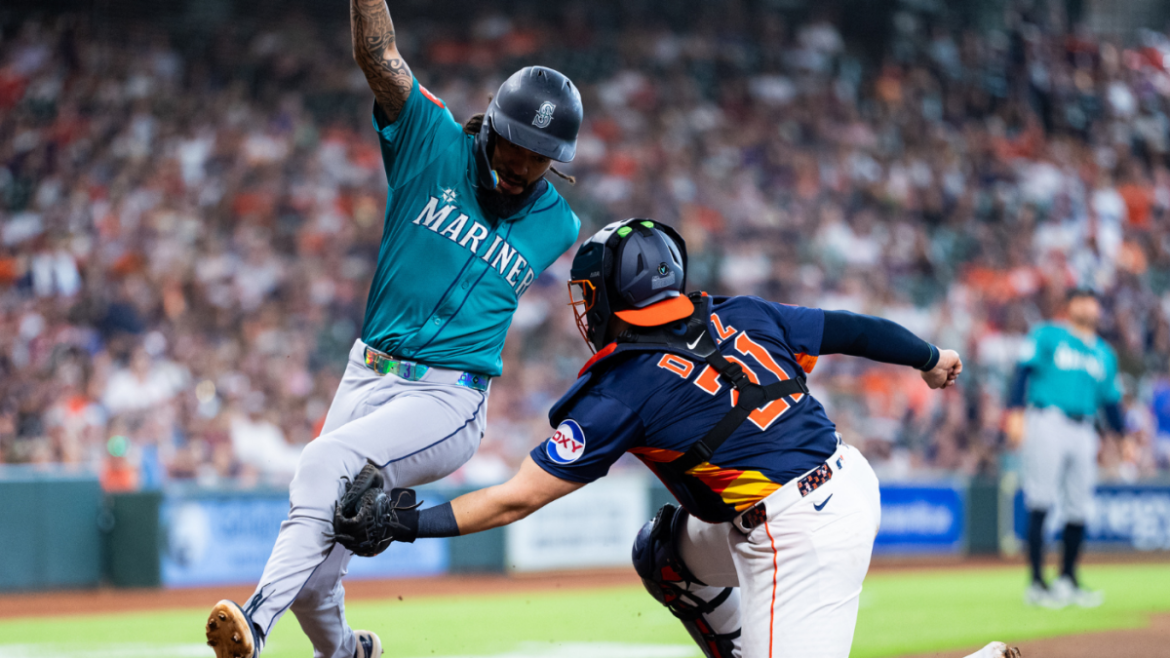
The latest houston astros vs seattle mariners match player stats show two very different games in Seattle during the September 2026 series. On September 22, the Astros produced a dominant 7-0 victory, collecting 12 hits while limiting the Mariners to only four. The following night was much closer, with Seattle overcoming Houston 6-5 in 10 innings at T-Mobile Park.
For readers looking at individual performances, Yordan Alvarez, Yainer Diaz, Isaac Paredes, Jose Altuve, Julio Rodríguez, Dominic Canzone, and Randy Arozarena were among the most important names in the two games. Alvarez delivered a two-hit, three-RBI performance in the September 22 win, while Diaz produced two hits, a home run, a triple, and three RBIs in the extra-inning game on September 23.
Houston Astros vs Seattle Mariners Match Player Stats: September 22 Game
Houston won the first game of the series, winning 7-0. The Astros scored in the first inning, added three runs in the third, scored again in the sixth, and finished with two more runs in the eighth. Houston had 12 hits and committed no errors, while Seattle managed only four hits and made one error.
Yordan Alvarez was one of the central offensive performers. He went 2-for-4 with a run, one walk, and three RBIs. His production was particularly important because Houston did not rely on just one big swing. The Astros consistently put runners on base and converted those opportunities into runs.
Jose Altuve scored once. Yainer Diaz also hit two for five. Jeremy Peña finished 1-for-4, scored twice, and stole a base. Together, those performances explain why Houston finished with 12 hits rather than depending exclusively on its biggest sluggers.
Yordan Alvarez and the Houston Offensive Attack
Alvarez’s performance deserves particular attention when analyzing the Houston Astros vs Seattle Mariners match player stats. His 2-for-4 line included three RBIs and a walk, giving him several ways to influence the game. He created damage both by reaching base and by driving runners home.
Paredes and Walker also produced, combining for two home runs and four RBIs. That combination made the lineup difficult for Seattle’s pitching staff to contain. Houston finished with three home runs overall, 12 total hits, and seven runs.
The first inning showed how Houston established pressure early. Peña singled and stole second before Alvarez singled him home. Paredes then singled, while Altuve added another hit. Houston’s ability to string together productive at-bats helped create an early advantage before the Mariners could settle into the game.
Houston Pitching and Seattle’s Offensive Numbers
Houston’s pitching staff completely shut down Seattle in the September 22 matchup. The Mariners recorded only four hits and failed to score in any of the nine innings. Logan Gilbert started for Seattle and was charged with the loss after allowing four earned runs over four innings while striking out three.
Miguel Ullola earned the victory for Houston. He worked two innings without allowing an earned run and recorded two strikeouts. The overall pitching effort was more important than any individual line because Houston prevented Seattle’s lineup from creating sustained pressure.
For Seattle, Julio Rodríguez was among the players who managed to produce hits, but the Mariners could not turn their limited opportunities into runs. The team finished with four hits and nine runners left on base, illustrating how difficult it was for Seattle to capitalize on its chances.
Houston Astros vs Seattle Mariners Match Player Stats: September 23 Game
The second matchup produced a completely different statistical story. Seattle defeated Houston 6-5 in 10 innings after the Astros took a 5-4 lead in the top of the 10th. The Mariners answered with two runs in the bottom half of the inning, turning the game around in dramatic fashion.
Houston finished with 10 hits, while Seattle had nine. Both teams played error-free baseball. The Astros scored all four of their regulation runs in the third inning, while Seattle answered with three runs in the third and one in the fifth. Neither team scored again until the 10th inning.
Yainer Diaz was the standout Houston hitter. He went 2-for-5, scored once, hit a home run, drove in three runs, and later tripled in the 10th inning to bring Houston ahead 5-4. His performance was one of the most complete offensive displays of the matchup.
Yainer Diaz’s Home Run and Triple
Diaz’s numbers provide one of the clearest examples of why individual player statistics can tell a deeper story than the final score. His third-inning home run came with a runner aboard and helped Houston establish a four-run lead. Later, his triple in the 10th inning gave the Astros a 5-4 advantage.
Despite that production, Seattle responded immediately. The Astros were unable to close out the game, and Diaz’s excellent offensive performance ultimately came in a losing effort. This is an important distinction when evaluating player statistics: a strong individual box score does not necessarily translate into a team victory.
Diaz finished with two hits in five at-bats, three RBIs, and one run. His home run and triple also gave him seven total bases. Those numbers made him one of the most productive hitters in the entire matchup.
Julio Rodríguez and Seattle’s Response
Julio Rodríguez was one of Seattle’s most important offensive players in the 6-5 victory. He went 3-for-4 with a double, two RBIs, and a walk. His performance gave Seattle consistent contact throughout the game and helped keep the Mariners within reach after Houston’s four-run third inning.
Dominic Canzone was another major contributor. He went 2-for-5 and drove in three runs. His production was particularly valuable because Seattle needed multiple offensive contributions rather than one isolated big play. Canzone helped bring the Mariners back after Houston’s early advantage.
Randy Arozarena also had an important game. He went 1-for-3, drew two walks, scored three runs, and stole a base. His ability to reach base and advance created opportunities for the hitters behind him. J.P. Crawford scored twice after going 1-for-5.
The Tenth-Inning Finish and Pitching Stats
The 10th inning was the defining part of the second matchup. Houston scored once in the top half when Diaz tripled, putting the Astros ahead 5-4. Seattle then loaded the bases in the bottom half. Julio Rodríguez drew a bases-loaded walk to tie the game before Josh Naylor delivered the winning single.
Josh Hader was charged with the loss for Houston. He worked 1⅓ innings and allowed two runs, one earned, while issuing four walks and recording no strikeouts. Cooper Criswell earned the win for Seattle after pitching one inning, allowing one hit and striking out one batter.
The contrast between the two pitching performances is significant. Houston’s bullpen had generally kept Seattle from scoring during the middle innings, but the final inning became a problem. Seattle’s ability to force walks and create traffic on the bases ultimately produced the winning run.
Comparing the Two Games Statistically
Looking at both games together gives a more complete picture of the Houston Astros vs Seattle Mariners match player stats. Houston won the first game 7-0 with 12 hits and three home runs. Seattle won the second 6-5 despite recording nine hits to Houston’s 10. The offensive pattern also changed considerably. In the first game, Houston’s lineup controlled the contest from beginning to end.
In the second, the Astros produced four runs in one inning and another in extra innings but could not maintain the advantage. Seattle’s second-game comeback demonstrated the value of getting runners on base. Arozarena reached base three times, Rodríguez reached four times through three hits and a walk, and Seattle eventually created enough traffic to force the tying run home.
The pitching statistics show a similar contrast. Houston held Seattle scoreless in the first game, while the Mariners scored six runs across 10 innings in the second. Seattle’s pitching staff also struck out 13 Houston batters in the second game, although Houston still managed 10 hits.
What the Player Statistics Reveal About Both Lineups
The numbers show that Houston’s offense featured several high-impact middle-order hitters. Alvarez, Paredes, Walker, and Diaz all produced significant run-generating moments across the two games. Altuve also contributed multiple hits in both matchups.
Seattle, meanwhile, demonstrated more balanced production in the extra-inning victory. Rodríguez and Canzone supplied important hits and RBIs, while Arozarena repeatedly reached base. Naylor provided the final hit when the game was on the line.
This difference is useful for readers searching for player statistics because it demonstrates why a simple batting-average comparison does not tell the whole story. Runs, RBIs, walks, extra-base hits, total bases, pitching innings, strikeouts, and late-inning performance all contributed to the final outcomes.
Why the September 2026 Series Matters
The games took place during the final stretch of the 2026 regular season, making every result particularly significant in the American League West race. After the September 22 game, Houston’s record stood at 78-79 while Seattle was 73-84. After Seattle’s September 23 victory, the Astros moved to 78-80 and the Mariners to 74-84.
The Mariners’ extra-inning victory was especially notable because it kept them mathematically involved in the division race at that stage of the season. MLB described Seattle as remaining technically alive after the walk-off win.
For Houston, the two-game split represented a combination of dominant pitching and frustrating late-game execution. The Astros showed how effective their lineup could be in the first game, then produced another strong offensive performance in the second without getting the victory.
How to Read Houston Astros vs Seattle Mariners Match Player Stats
When examining a box score from an Astros-Mariners matchup, batting average is only one part of the picture. At-bats and hits show contact production, while runs and RBIs provide context about how those hits affected scoring. Walks can be especially important in close games because they create additional baserunners without requiring a hit.
For pitchers, innings pitched, earned runs, strikeouts, and walks provide a basic picture of performance. In a late-season game, bullpen usage can be just as important as the starting pitcher’s statistics because relief pitchers often determine whether an early lead survives into the final innings.
Conclusion
The houston astros vs seattle mariners match player stats from September 2026 show how dramatically a baseball series can change from one game to the next. Houston dominated the September 22 matchup 7-0 behind 12 hits, three home runs, strong pitching, and major contributions from Yordan Alvarez, Isaac Paredes, and Christian Walker.
The statistics also show why individual box-score numbers need to be considered in context. For readers following these teams, the most useful approach is to examine hitting production, pitching efficiency, baserunning, and late-inning execution together rather than relying on one statistic alone.
Also Read Here: Bengals vs Detroit Lions match player stats



1 thought on “Houston Astros vs Seattle Mariners Match Player Stats: Full Breakdown of the September 2026 Series”