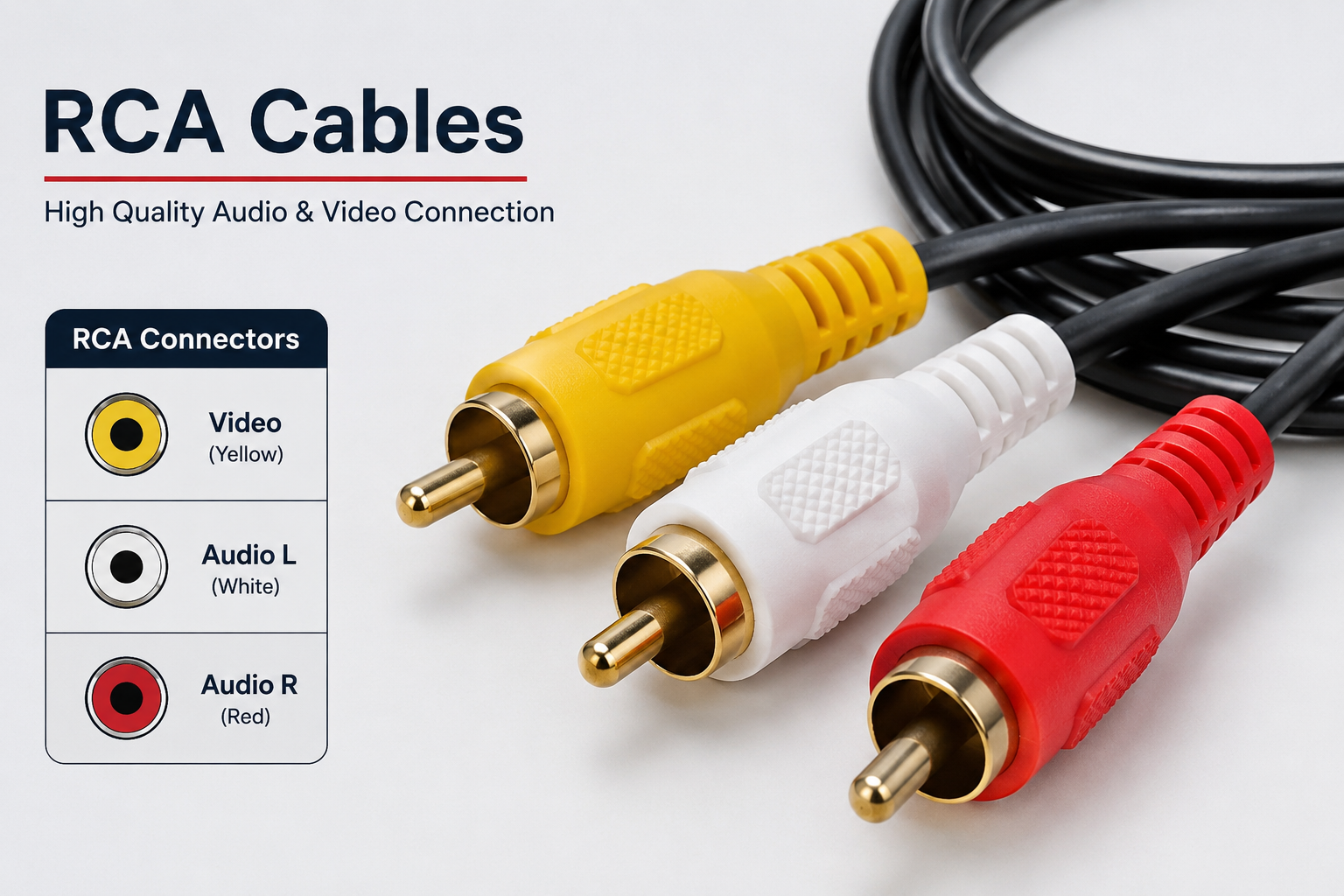
RCA cables have been part of home entertainment and audio equipment for decades, providing a simple and familiar way to connect devices and transfer audio or video signals. Although newer technologies such as HDMI, USB, Bluetooth, optical audio, and wireless streaming have become common, RCA cables remain useful in many homes, studios, vehicles, and professional setups. Their recognizable connectors and straightforward design make them easy to identify and use. Whether you are connecting a turntable to an amplifier, a DVD player to an older television, a game console to a display, or an audio component to powered speakers, understanding RCA cables can help you choose the right connection and avoid common setup problems.
Table of Contents
ToggleWhat Are RCA Cables?
RCA cables are connection cables designed to carry audio and video signals between compatible electronic devices. The name comes from Radio Corporation of America, which helped popularize the connector design during the twentieth century. A traditional RCA cable uses small cylindrical connectors with a central pin and an outer conductive ring.
The connector is inserted into a matching RCA jack on an electronic device, creating a physical connection for the signal. Many RCA cables come with two connectors for stereo audio, while others use three connectors for stereo audio and composite video. The simplicity of the RCA connection is one reason it became such a widespread standard.
How RCA Connections Work
A traditional RCA connection carries an electrical signal from an output device to an input device. In an analog audio setup, the source equipment converts audio information into an electrical waveform. The RCA cable transports that signal through its conductor to another component, where the receiving equipment processes and amplifies it. A stereo RCA connection normally uses two separate signal paths, one for the left channel and another for the right channel.
Connectors are commonly identified by colors to make installation easier. Red typically represents the right audio channel, while white or black commonly represents the left channel. Composite video RCA connections often use yellow for video. These colors are conventions rather than a fundamental requirement of the cable itself, but following them helps prevent connection mistakes.
Understanding Stereo RCA Cables
Stereo RCA cables are among the most common forms of RCA cables. They typically have two connectors on each end, creating separate left and right audio channels. This configuration allows a stereo source to send distinct audio information to the left and right sides of a sound system. For example, someone connecting a CD player to a stereo amplifier would generally connect the player’s left and right RCA outputs to the corresponding inputs on the amplifier.
Maintaining the correct channel orientation helps preserve the intended stereo soundstage. If the red and white connectors are accidentally reversed, the system may still produce sound, but the left and right channels will be swapped. This is usually easy to correct by matching each connector to the appropriately labeled input.
RCA Cables for Composite Video
RCA connectors were also widely used for composite video systems. A traditional composite connection normally uses three RCA cables: one yellow connector for the video signal, one white connector for the left audio channel, and one red connector for the right audio channel. This arrangement became common with devices such as VCRs, DVD players, older game consoles, cable boxes, and standard-definition televisions.
Composite video combines video information into a single analog signal, which makes the setup simple but limits image quality compared with modern digital video standards. Although composite connections are less common on newer televisions, they remain relevant for people who use retro gaming consoles, vintage media players, or older home theater equipment.
RCA Cables and Analog Audio
One of the most important characteristics of RCA cables is that traditional RCA audio connections are analog. Analog audio represents sound through continuously varying electrical signals. This differs from digital connections, which transmit information using digital data. Because RCA carries an analog signal, the quality of the complete audio chain depends on the source device, cable construction, connectors, receiving equipment, and surrounding electrical environment.
A high-quality RCA cable cannot transform a low-quality source into high-fidelity audio. Still, a properly constructed cable can provide a reliable connection with appropriate shielding and durable connectors. Understanding this distinction can help users avoid spending money on features that do not provide meaningful benefits for their particular setup.
Shielding in RCA Cables
Shielding helps protect the signal carried by an RCA cable from unwanted electrical interference. This matters because analog audio signals are relatively susceptible to noise from nearby electrical devices, power supplies, lighting equipment, computers, and other electronics. RCA cables may use different shielding arrangements, including braided, foil, or combination shielding.
Good shielding can help maintain a cleaner signal, particularly when cables are routed near potential sources of electromagnetic interference. Cable routing also matters. Keeping audio cables separated from power cables when practical can reduce the chance of unwanted noise entering the audio system.
RCA Cables and Turntables
RCA cables are particularly important in vinyl record systems because many turntables provide RCA-style analog outputs. However, turntable connections can involve additional considerations. Some turntables have a built-in phono preamp, while others require an external phono preamp or an amplifier with a dedicated phono input.
The very low-level signal produced by a traditional phono cartridge requires appropriate amplification and equalization before it can be connected to a standard line-level input. Simply using a different RCA cable cannot solve a mismatch between phono-level and line-level signals. When setting up a turntable, users should therefore check whether the turntable has a built-in preamp and whether the receiving device has a compatible phono input.
RCA Cables for Subwoofers
Powered subwoofers commonly use RCA connections to receive low-frequency audio information from an AV receiver, integrated amplifier, or other audio equipment. Some systems provide a dedicated subwoofer output, while others may use left and right line-level outputs. Subwoofer RCA cables are often marketed with additional shielding or thicker construction, but the most important consideration is compatibility and reliable signal transmission.
A cable does not need to be extraordinarily expensive simply because it is being used with a subwoofer. Properly connecting the subwoofer output to the appropriate input and configuring the receiver correctly generally has a greater impact on system performance than choosing an extravagant cable.
RCA Versus Optical Audio
Optical audio connections, often called TOSLINK, transmit digital audio using light rather than electrical analog signals. RCA analog audio connections transmit separate electrical signals for the audio channels. Optical can be useful when a device supports digital audio and the user wants to avoid certain forms of electrical interference.
RCA, meanwhile, is often more convenient for traditional analog equipment such as older amplifiers, mixers, and turntables. Neither connection is universally better because they operate differently and support different equipment. The correct choice depends on whether the source and receiving devices are designed to use analog or digital audio and what audio formats the system needs to handle.
RCA Versus 3.5mm Audio Connections
A 3.5mm connector is frequently found on headphones, laptops, smartphones, portable music players, and compact audio devices. RCA is more common on home stereo components and other larger equipment. An RCA-to-3.5mm cable or adapter can connect a portable source to a stereo amplifier with RCA inputs.
In a typical setup, the 3.5mm end carries left and right audio channels while the RCA side separates those channels into individual connectors. Such cables are convenient for connecting devices with different physical interfaces. Users should nevertheless check whether the output and input levels are compatible and whether the equipment expects stereo or another signal configuration.
Common RCA Cable Problems
RCA connections are simple, but several common problems can affect performance. Users may experience no sound, one missing stereo channel, buzzing, crackling, or intermittent connections. A loose connector is one of the easiest problems to identify.
Damaged cables can also cause signal loss, particularly if the conductor or connector has been stressed repeatedly. Incorrect input selection on an amplifier or receiver can make a perfectly functional cable appear defective. Another common issue occurs when left and right channels are connected incorrectly.
Final Thoughts
RCA cables remain a practical and reliable choice for connecting audio and video equipment, especially in traditional home entertainment setups. While newer digital connections such as HDMI, optical, and USB have become more common, RCA cables continue to offer simple installation, broad compatibility, and dependable performance.
Choosing the right cable, using suitable connectors, and avoiding unnecessary interference can help ensure clean and consistent signal transmission. For anyone working with older or compatible audio equipment, RCA cables are still a useful and affordable connection solution.
Also Read Here: Geometry Spot



1 thought on “Understanding RCA Cables: From Basic Connections to Advanced Setups”