What Is a Warmup Cache Request?
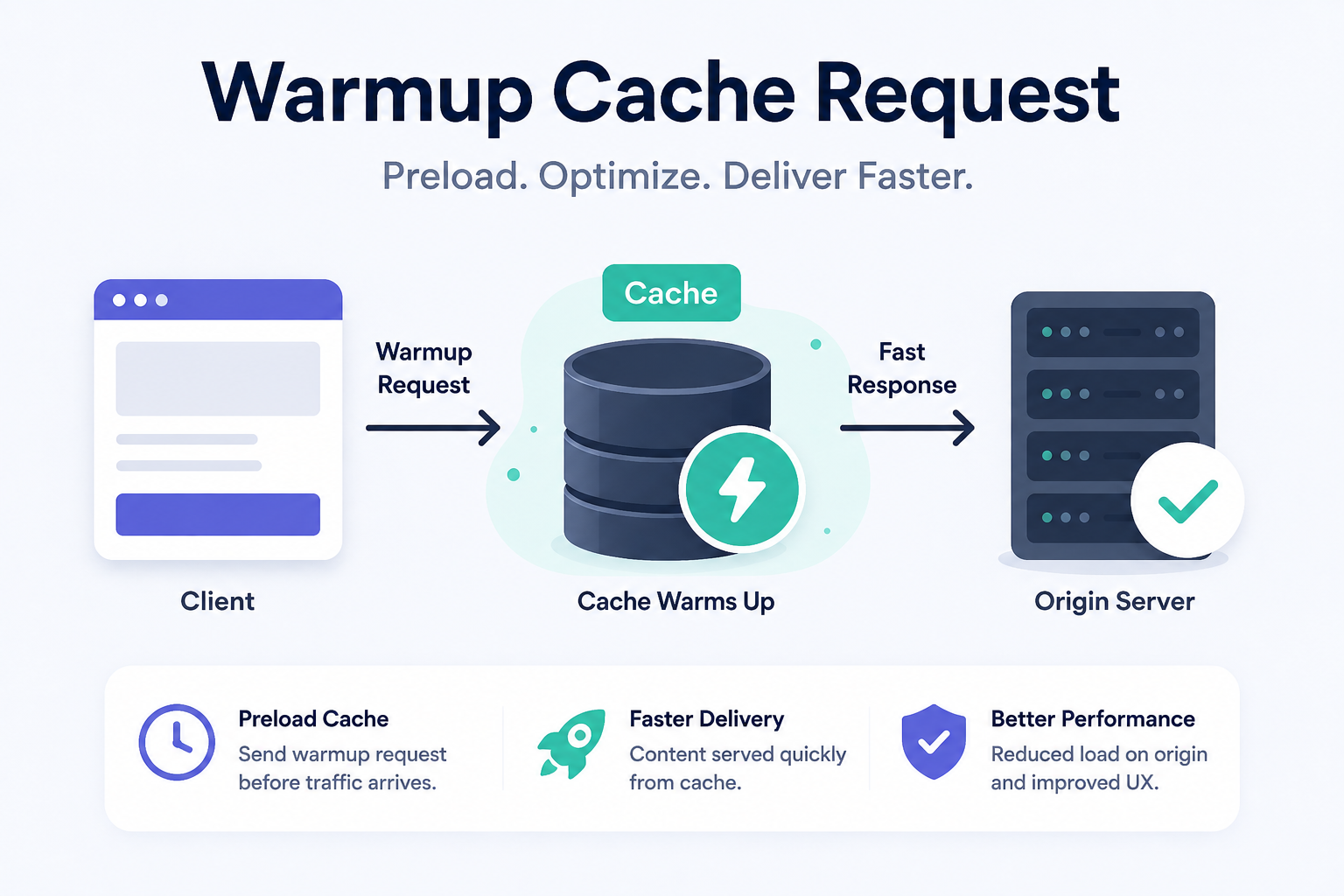
A Warmup Cache Request is a web performance optimization technique that prepares cached content before users request it. Instead of waiting for the first visitor to open a page and trigger the process of generating and storing a cached version, a system can send a request ahead of time so the content is ready when real users arrive.
This approach can reduce initial response time, improve page-loading consistency, and reduce the work required from the origin server. Cache warming is particularly useful for websites that experience predictable traffic patterns, newly published content, large promotional campaigns, or sudden increases in visitors.
Why Cache Warming Matters
Caching is one of the most common ways to improve website performance. When a visitor requests a page, the server normally has to process the request, retrieve information from a database, execute application logic, generate the response, and send the result back to the browser. With caching, a previously generated response can be stored temporarily and served much faster.
A cache is not always populated automatically. If a page has expired from the cache or has never been requested before, the first visitor may experience a slower response while the server creates the cached version. A Warmup Cache Request solves this problem by creating or refreshing the cached content before normal users need it.
How a Warmup Cache Request Works
The basic process behind a Warmup Cache Request is relatively straightforward. A system identifies important URLs that should be available in the cache and sends requests to those URLs before expected traffic arrives. The caching layer receives the request and checks whether a usable cached object already exists. If it does not, the request can travel to the origin server, where the page is generated.
The resulting response is then stored in the cache according to the configured caching rules. When an actual visitor requests the same resource afterward, the caching system can return the stored response without requiring the origin application to regenerate the page immediately. This makes the first-user experience much more similar to the experience of later visitors.
Benefits for Website Performance
One of the biggest benefits of a Warmup Cache Request is improved performance. When frequently requested pages are already cached, visitors may receive responses much faster because the caching layer does not need to contact the origin server for every request. Faster response times can make websites feel more responsive and can reduce delays during busy periods.
Cache warming can also make performance more predictable because important pages are less likely to suffer from the slow response associated with an empty or expired cache. For websites where milliseconds matter, proactive cache preparation can become an important part of a broader performance strategy.
Cache Warming for Ecommerce Websites
Ecommerce websites can benefit significantly from proactive caching, although dynamic content requires careful handling. Product descriptions, category pages, informational pages, and other relatively stable resources can often be cached effectively. Before a sale or promotional campaign begins, a business can warm the cache for high-demand product and category pages.
This can help the website handle increased browsing activity without forcing every request to reach the application server. However, personalized information such as shopping carts, account details, inventory-sensitive data, and checkout information may require different caching strategies. Cache warming should therefore focus on resources that can safely be served from shared cache layers.
Warmup Cache Requests and Content Delivery Networks
Content delivery networks, commonly known as CDNs, are frequently used alongside cache warming. A CDN stores cached resources at strategically distributed edge locations so visitors can receive content from infrastructure closer to them. Depending on the CDN configuration, a Warmup Cache Request can help populate selected cache locations before users begin arriving.
This can be particularly useful for geographically distributed audiences. If an event is expected to generate international traffic, a website may need to consider more than whether an object is cached somewhere. It may also need to consider where the cached object is available and how the CDN handles cache population across its network.
Understanding Cache Hits and Cache Misses
To understand why cache warming is useful, it helps to understand cache hits and cache misses. A cache hit occurs when the caching system already has a valid response for a requested resource and can serve it directly. A cache miss happens when the required object is unavailable, expired, or otherwise unsuitable for reuse.
A miss generally requires additional processing and may result in an origin request. The goal of cache warming is not necessarily to eliminate every cache miss across an entire website. Instead, it is usually used to reduce misses for high-value resources where performance is especially important.
Choosing Which URLs to Warm
Not every URL needs to be included in a Warmup Cache Request process. Warming thousands or millions of URLs unnecessarily can waste server resources and may actually create additional load. A better approach is to prioritize pages according to traffic, business importance, expected demand, and computational cost.
Popular landing pages, major product pages, important category pages, frequently accessed documentation, and newly published high-priority content are common candidates. Historical analytics can help identify which URLs consistently attract visitors. A website can then create a prioritized list instead of attempting to warm every resource indiscriminately.
Cache Warming Before Scheduled Events
Scheduled events provide an excellent opportunity for planned cache warming. A company might know that a campaign will launch at a particular hour, a ticket sale will begin on a specific date, or a major announcement will attract visitors shortly after publication. The cache-warming process can be scheduled shortly before the anticipated traffic increase.
This gives the system enough time to generate and store the required content while avoiding unnecessary repeated requests too far in advance. Planning around real traffic patterns makes cache warming more efficient and reduces the risk of generating cached content that expires before users need it.
Cache Warming and Dynamic Content
Dynamic content presents additional challenges because not every response is safe or useful to cache. Pages may change based on user identity, location, cookies, session information, device type, or real-time data. If a personalized response is accidentally stored in a shared cache, another visitor could potentially receive incorrect content.
For this reason, cache rules should clearly distinguish between public cacheable resources and private or personalized responses. Warmup requests should generally target resources that multiple visitors can access. Developers should carefully review headers, cookies, authentication requirements, and cache keys before implementing an automated warming system.
Using Warmup Requests With APIs
APIs can sometimes benefit from cache warming as well. Public API responses that are expensive to generate but do not change frequently can be cached for a defined period. A Warmup Cache Request can populate those responses before an application needs them.
This may be useful for dashboards, public datasets, documentation systems, search-related resources, or other services where repeated requests frequently ask for the same information. However, API caching must be designed carefully because data freshness and authorization requirements can vary considerably.
Automating Warmup Cache Requests
Automation makes cache warming more practical for larger websites. Instead of manually requesting individual URLs, a system can generate a list of priority resources and process them on a schedule. The automation might run after publishing new content, before scheduled campaigns, after cache invalidation, or at regular intervals.
A good system can also detect whether a URL already has a valid cached version and avoid unnecessary requests. The exact implementation depends on the website architecture, caching platform, CDN, server environment, and application framework. The main goal should be controlled and predictable cache preparation.
Final Thoughts
A Warmup Cache Request is a practical performance technique that prepares cached resources before real users need them. By turning cache population from a purely reactive process into a proactive one, websites can reduce initial response delays, protect origin infrastructure, and provide more consistent performance during traffic spikes.
The technique is especially useful for popular pages, scheduled campaigns, newly published content, ecommerce events, and expensive dynamic resources that can safely be shared through a cache. However, effective cache warming requires thoughtful URL selection, controlled request rates, correct cache policies, and ongoing monitoring.
Also Read Here: XFi Complete



1 thought on “Warmup Cache Request: The Proactive Method for Better Cache Efficiency”