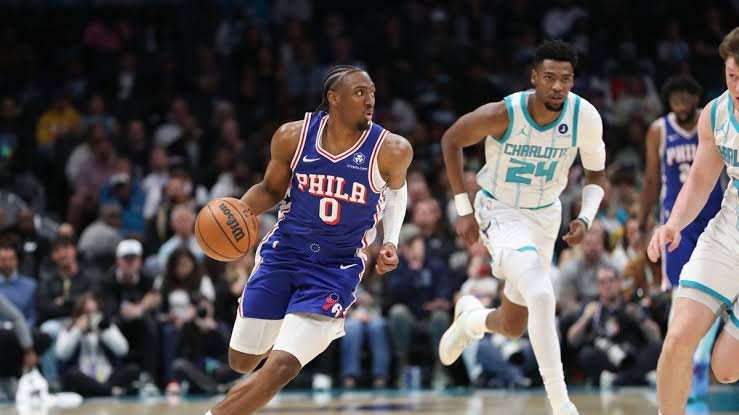
The 76ers vs Charlotte Hornets match player stats provide a useful way to examine how individual performances, scoring efficiency, rebounding, playmaking, and defensive pressure shape this Eastern Conference matchup. Philadelphia and Charlotte bring different strengths to the court, making their head-to-head meetings interesting for basketball fans who want to understand more than the final score. Individual statistics help reveal which players influence the tempo, create scoring opportunities, protect the basket, and make the difference during crucial possessions.
76ers vs Charlotte Hornets Match Player Stats: Game Overview
The March 28, 2026, meeting between the Philadelphia 76ers and Charlotte Hornets delivered one of the more dramatic finishes of their regular-season series. Philadelphia secured a 118–114 victory at Spectrum Center in Charlotte after overcoming a 15-point deficit. Joel Embiid led the 76ers with 29 points, while Tyrese Maxey and Paul George each contributed 26 points.
The final score only tells part of the story. Charlotte controlled the opening quarter and built a substantial advantage during the third period, but Philadelphia responded with improved execution and greater composure in the closing minutes. The performances of Embiid, Maxey, and George demonstrated how multiple scoring options can change a game even when a team struggles early.
Joel Embiid’s Scoring Performance and Influence
Joel Embiid was Philadelphia’s leading scorer with 29 points, giving the 76ers a dependable offensive option throughout the contest. His ability to score around the basket, draw defensive attention, and create opportunities from the free-throw line helped Philadelphia remain competitive when the 76ers vs charlotte hornets match player stats threatened to take control.
Embiid’s scoring was particularly important during the first half, when the 76ers needed to recover from Charlotte’s strong start. The Hornets scored 36 points in the opening quarter, establishing an early advantage, but Embiid helped Philadelphia produce a 39-point second quarter.
Tyrese Maxey’s Return Changed Philadelphia’s Offense
Tyrese Maxey recorded 26 points, eight assists, and seven rebounds in his return to Philadelphia’s starting lineup. Maxey immediately provided the 76ers with another player capable of creating shots, attacking open lanes, and distributing the ball under pressure.
His seven rebounds added value beyond the backcourt scoring role. Rebounding from a guard can help initiate transition opportunities and reduce the opposition’s chances of extending possessions. Although Maxey’s biggest contribution was his scoring, the combination of points, assists, and rebounds reflected a broad performance.
His impact became particularly visible in the fourth quarter, when he tied the game at 97 with a powerful dunk before helping Philadelphia move in front. The sequence represented a turning point because Charlotte had held the advantage for much of the game.
Paul George Delivered a Complete Two-Way Performance
Paul George finished with 26 points and 13 rebounds, making him one of Philadelphia’s most influential players in the matchup. He shot nine of 19 from the field, including four of 11 from three-point range, and added two assists and four steals. His shooting figures represent approximately 47.4% from the field and 36.4% from beyond the arc.
For anyone examining the player statistics, George’s combination of 26 points, 13 rebounds, and four steals deserves particular attention. His performance supported the offense, strengthened Philadelphia’s defensive activity, and provided the decisive late-game scoring. The contribution was a reminder that a player’s value cannot be understood through points alone.
Brandon Miller Led Charlotte’s Scoring Effort
He made eight of 17 field-goal attempts and connected on five of 11 three-point attempts, shooting approximately 47.1% overall and 45.5% from long range. Miller also converted eight of 10 free throws, giving him an effective combination of perimeter shooting and scoring opportunities at the line.
Miller’s offensive production helped Charlotte establish early control. He scored 18 points during the first half, including a strong opening quarter in which the Hornets built a 36–25 advantage. His ability to convert perimeter opportunities forced Philadelphia to respect his shooting range, while his willingness to attack created additional pressure on the visiting defense.
Miller’s 29 points remain one of the central figures in the box score. His efficiency from three-point range helped Charlotte maintain pressure on Philadelphia, and his first-half production established the foundation for the Hornets’ early lead. Even in defeat, his performance demonstrated why his perimeter scoring was a major factor in the contest.
LaMelo Ball’s Playmaking and Scoring Numbers
LaMelo Ball recorded 20 points and eight assists for Charlotte, contributing to both the team’s scoring and its creation of opportunities for other players. He made seven of 26 field-goal attempts, including five of 18 from three-point range, and finished with three rebounds. His overall field-goal percentage was approximately 26.9%, while his three-point percentage was approximately 27.8%.
His scoring, however, was less efficient than Miller’s. Ball attempted 26 field goals, making seven, which meant Charlotte needed a high volume of attempts to reach his 20-point total. His five three-pointers provided valuable scoring, but the overall shooting percentage suggests that Philadelphia made some of his attempts difficult.
Moussa Diabaté and Charlotte’s Work on the Boards
Moussa Diabaté contributed 10 points and 11 rebounds for Charlotte, recording a double-double. He made four of seven field-goal attempts and converted two of three free throws. His rebounding total tied for the highest on the Hornets, alongside Kon Knueppel, and his work around the basket gave Charlotte an important interior presence.
Diabaté’s 11 rebounds reflected his role in securing missed shots and creating additional opportunities for his team. Rebounds are particularly important in a matchup where both teams generate substantial scoring runs. Defensive boards help prevent second-chance points, while offensive rebounds can produce extra attempts when the initial shot misses.
Charlotte’s rebounding numbers were strong overall, but the result showed that winning the battle for individual rebounds does not automatically guarantee victory. Philadelphia still managed to recover from its deficit by improving its offensive execution and converting crucial opportunities late in the game.
Kon Knueppel and Miles Bridges Add Supporting Production
Kon Knueppel finished with 11 points and 11 rebounds, recording a double-double of his own. He made three of 14 field-goal attempts and three of 10 three-point attempts, while adding two assists. His 11 rebounds gave Charlotte another reliable contributor on the glass, helping the team compete for possessions against Philadelphia’s larger frontcourt players.
Miles Bridges added 11 points and six rebounds, shooting four of nine from the field. He also contributed one assist and made one three-pointer. His performance offered Charlotte another source of frontcourt scoring and rebounding, helping support the production from Miller, Ball, and Diabaté.
Coby White’s Contribution From the Bench
Coby White scored 16 points in 18 minutes and 41 seconds of playing time, providing Charlotte with an additional scoring option. He made six of 11 field-goal attempts, including one of four three-point attempts, and added four rebounds, two assists, and one steal.
White’s production was significant because bench scoring can help a team maintain offensive pressure when starters rest or face difficult defensive matchups. His ability to score efficiently gave Charlotte another option beyond Miller and Ball. He also contributed rebounds and assists, allowing his performance to extend beyond simply finishing possessions.
His 16 points did not prevent the late collapse, but they helped Charlotte maintain offensive depth. For analysts studying the 76ers vs Charlotte Hornets match player stats, White’s performance is a reminder that secondary scorers can have a meaningful effect on the contest even when they do not receive the same attention as the leading players.
Team Statistics Explain Philadelphia’s Comeback
The final team statistics reveal how Philadelphia overcame Charlotte’s early advantage. The 76ers won 118–114 despite trailing 36–25 after the opening quarter. Both teams scored 28 points in the third quarter, leaving the contest within reach, before Philadelphia outscored Charlotte 26–17 in the final period.
Charlotte received stronger bench scoring and produced a large first-quarter lead, but Philadelphia found more success in transition and around the basket. The 76ers also avoided giving away more possessions through turnovers, matching Charlotte’s total. In a four-point game, those small differences can be decisive.
Shooting Efficiency and Three-Point Performance
Shooting percentages are among the most useful statistics for understanding why a game develops the way it does. Miller’s 47.1% field-goal shooting and 45.5% accuracy from three-point range provided Charlotte with efficient scoring. These three Philadelphia scorers gave the 76ers several ways to attack the defense rather than depending entirely on perimeter shooting.
That difference highlights why points alone can be misleading. Shooting percentage provides additional context, although it should also be considered alongside free throws, three-point attempts, assists, defensive attention, and the difficulty of the shots taken.
The Hornets’ ability to hit long-range shots helped establish their lead, but Philadelphia’s attack became increasingly effective as the game progressed. Ultimately, shot quality and execution in the final minutes mattered more than any single shooting statistic.
Defensive Plays and Fourth-Quarter Pressure
Defense became the decisive factor when the game entered its closing stages. Philadelphia needed to contain Charlotte’s perimeter threats while avoiding unnecessary fouls and protecting the basket. George’s four steals contributed to the 76ers’ defensive activity, while Embiid’s late block provided the defining moment of the final possessions.
The closing sequence demonstrated the value of composure. George converted the decisive three-pointer, Charlotte committed a turnover on its next possession, and Embiid blocked Miller’s potential tying attempt. Philadelphia made the important plays when the game was on the line, while Charlotte could not find the final basket needed to force another lead change.
What the Match Player Stats Reveal About Both Teams
The Philadelphia 76ers’ victory highlighted the advantages of balanced star production. Embiid led the team with 29 points, while Maxey and George added 26 apiece. Maxey contributed eight assists and seven rebounds, and George combined his scoring with 13 rebounds and four steals.
Charlotte also received excellent individual performances. Miller matched Embiid’s 29-point total, Ball scored 20 points and recorded eight assists, Diabaté posted a double-double, and White contributed 16 points on efficient shooting. Knueppel also collected 11 rebounds.
The broader lesson is that basketball statistics are most useful when read together. Points measure scoring output, assists reveal playmaking, rebounds indicate possession control, shooting percentages provide efficiency context, and defensive statistics help explain how teams disrupt opponents.
Final Thoughts
The March 28, 2026, matchup between Philadelphia and Charlotte demonstrated how quickly an NBA game can change when a team improves its execution under pressure. Philadelphia recovered from a 15-point deficit to win 118–114, with Embiid, Maxey, and George providing 81 combined points.
For readers researching the 76ers vs Charlotte Hornets match player stats, the most important takeaway is that the result was shaped by more than the leading scorers. Philadelphia’s interior scoring, transition offense, defensive pressure, and late-game composure helped secure the win.
Also Read Here: Atlanta Braves vs Minnesota Twins match player stats


1 thought on “76ers vs Charlotte Hornets Match Player Stats: The Numbers Behind the Battle”