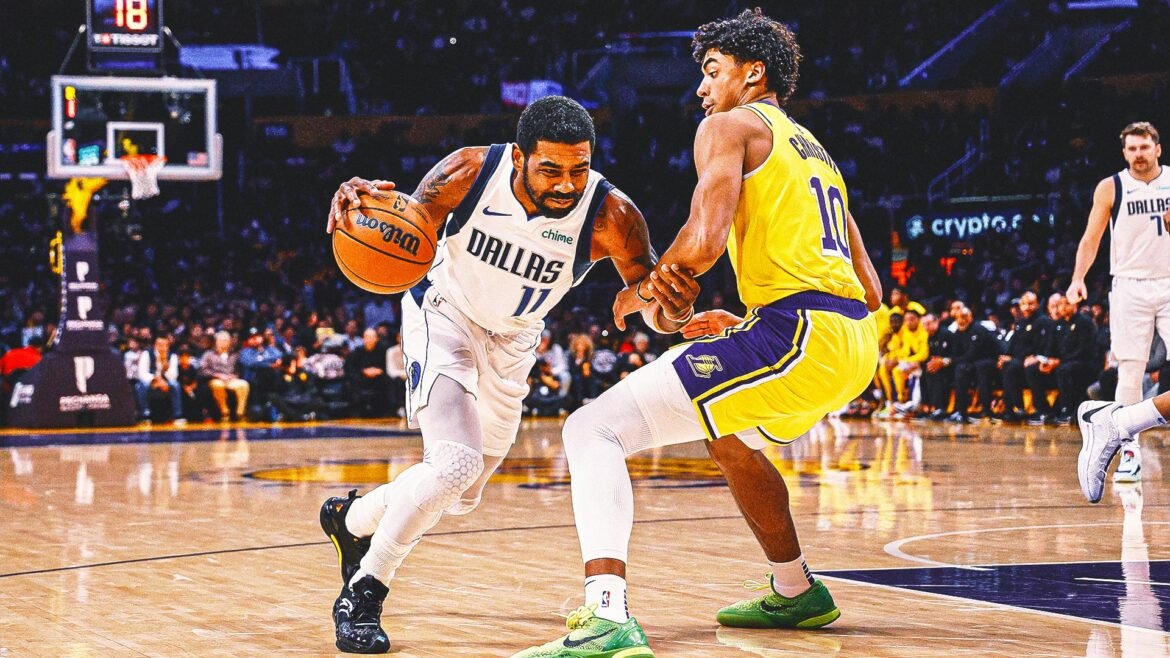
The Lakers vs Dallas Mavericks match player stats from the April 5, 2026, NBA regular-season matchup tell the story of a high-scoring contest in which Dallas defeated Los Angeles 134–128. Cooper Flagg delivered a standout 45-point performance for the Mavericks, while LeBron James contributed 30 points and 15 assists for the Lakers. The result highlighted the difference between Dallas’s scoring punch and Los Angeles’s ability to create opportunities through its veteran playmaker. The matchup is particularly interesting because the final score alone does not explain how the game unfolded.
Cooper Flagg’s 45 Points Set the Tone for Dallas
Cooper Flagg was the central figure in Dallas’s victory, finishing with 45 points, eight rebounds, nine assists, two steals, and one block in 38 minutes and 31 seconds. He shot 14-for-27 from the field, made two of his four three-point attempts, and converted 15 of 17 free throws.
Flagg’s performance was valuable because it extended beyond scoring. His nine assists demonstrated that he could create opportunities for teammates when defenders focused on stopping his individual offense. The eight rebounds also helped Dallas finish possessions and transition into its next attack.
LeBron James Delivered a Powerful All-Around Performance
LeBron James recorded 30 points, nine rebounds, and 15 assists for Los Angeles. He played 38 minutes and 43 seconds, shooting 12-for-22 from the field and making one three-pointer on six attempts. His five successful free throws came from nine attempts. James also registered one steal and committed four turnovers.
The most revealing number in his stat line was 15 assists. James was not simply trying to match Flagg’s scoring output; he was also responsible for creating scoring opportunities for his teammates. His passing helped Los Angeles produce 128 points and gave several players opportunities to contribute offensively.
James’s nine rebounds added value on the defensive glass and in transition. His 30 points showed that he could remain a major scoring threat while handling the responsibilities of a primary playmaker. His four turnovers illustrate the difficulty of maintaining possession when a player has to create so much of the offense.
Jaxson Hayes Gave the Lakers an Important Scoring Boost
Jaxson Hayes was one of lakers vs dallas mavericks match player stats most productive contributors, scoring 23 points in 27 minutes and 12 seconds. He made eight of his 10 field-goal attempts and seven of his eight free throws, finishing with four rebounds and two assists. His three turnovers were a downside, but his shooting efficiency was a major positive for the Lakers.
His seven made free throws also helped him turn a limited number of field-goal attempts into a 23-point performance. That scoring support mattered in a game where Dallas reached 134 points. Hayes provided an effective interior option, but Los Angeles needed more defensive resistance to translate its offensive production into a victory.
Rui Hachimura Made the Most of His Shooting Opportunities
Rui Hachimura finished with 21 points and seven rebounds, shooting nine-for-13 from the field. He made three of five three-point attempts and added one assist and one steal without committing a turnover. His 69.2% field-goal accuracy made him one of the Lakers’ most efficient scorers in the matchup.
Hachimura’s performance was especially useful because he provided reliable scoring alongside James and Hayes. His ability to finish inside and connect from the perimeter gave the Lakers another offensive option. Defenses could not focus exclusively on James without accounting for Hachimura’s scoring potential.
Although he did not record a large number of assists, he played an important complementary role by converting his opportunities efficiently. His performance showed that Los Angeles had several productive individual scorers, even though the team’s overall defensive results were not enough to secure the win.
Luke Kennard’s Double-Double Added Playmaking and Rebounding
Luke Kennard recorded 15 points, 16 rebounds, and 11 assists in 41 minutes and 10 seconds. He made five of 17 field-goal attempts, including one of five from three-point range, and converted all four of his free throws. He also recorded one steal and committed three turnovers.
Kennard’s stat line is a useful reminder that a player’s impact cannot be assessed through points alone. Rebounding can extend possession opportunities, while assists help teammates convert offensive possessions into points. Even with an inconsistent shooting night, Kennard filled several important roles for Los Angeles.
Dallas Received Valuable Support From P.J. Washington and Naji Marshall
Flagg led Dallas in scoring, but the Mavericks also received useful contributions from their supporting players. P.J. Washington scored 15 points and collected six rebounds, shooting six-for-10 from the field and three-for-six from beyond the arc.
He made five of nine field-goal attempts, added three free throws, and recorded two steals. Marshall’s seven assists were particularly important because they helped distribute the playmaking workload rather than leaving Flagg responsible for every creation opportunity.
Brandon Williams also scored 13 points and provided five assists in 24 minutes and 36 seconds. He made four of seven field-goal attempts and converted five of seven free throws. His ability to add points and facilitate offense helped Dallas maintain production beyond its leading scorer.
Klay Thompson and the Mavericks’ Bench Provided Extra Scoring
Klay Thompson contributed 11 points in 18 minutes and 10 seconds, shooting four-for-eight from the field and three-for-six from three-point range. His three made triples offered Dallas another perimeter threat, particularly when the team needed scoring from players other than Flagg.
Marvin Bagley III added nine points and four rebounds, while Khris Middleton scored eight points on three-for-five shooting. Max Christie also finished with eight points, two rebounds, and two assists. Daniel Gafford recorded seven points, seven rebounds, two steals, and two blocks, providing a defensive presence near the basket.
Team Shooting Numbers Explain Dallas’s Offensive Advantage
The team shooting figures help explain why Dallas scored 134 points. The Mavericks made 46 of 88 field-goal attempts, a shooting percentage of 52.3%. They converted 14 of 32 three-point attempts, or 43.8%, and made 28 of 36 free throws, finishing at 77.8% from the line.
That combination gave Dallas a productive offensive night. The Mavericks were accurate inside and outside the three-point line, while their free-throw volume provided another reliable source of points. Making 14 three-pointers also meant that their perimeter shooting contributed 42 points to the final total.
Los Angeles scored 128 points, but Dallas’s six-point advantage suggests that the difference was not simply about whether the Lakers could score. Both teams produced high totals, and Los Angeles remained capable of answering Dallas’s offensive runs.
Three-Point Shooting and Free Throws Shaped the Final Margin
Dallas made 14 three-pointers, while the Mavericks’ overall three-point percentage reached 43.8%. Washington and Thompson each made three triples, while Flagg added two. Their combined perimeter production helped prevent the Lakers from concentrating all their defensive attention on the paint.
imura was one of Los Angeles’s most effective three-point shooters, making three of five attempts. However, James made only one of six attempts from beyond the arc, and Kennard converted one of five. Their combined four-for-17 shooting from three-point range was less efficient than Dallas’s team performance.
Rebounding and Ball Movement Tell a More Complete Story
Rebounding and assists provide further context for the final score. Los Angeles collected 49 rebounds and recorded 36 assists, while Dallas finished with 38 rebounds and 27 assists. The Lakers therefore had the advantage in both of these categories, even though they lost the game.
Those figures show why the final result should not be reduced to a simple statement that Dallas dominated every part of the game. The Lakers generated plenty of opportunities through rebounding and passing. James’s 15 assists and Kennard’s 11 were especially important in a lineup missing key offensive players.
Shooting accuracy, turnovers, defensive stops, and the timing of baskets all influence the outcome. Dallas made 52.3% of its field-goal attempts, while the Mavericks’ ability to convert important possessions helped offset Los Angeles’s statistical advantages in other areas.
Quarter-by-Quarter Scoring Shows How the Game Developed
Dallas established an early advantage by scoring 41 points in the first quarter, compared with 30 for Los Angeles. That 11-point difference created an early challenge for the Lakers and gave the Mavericks room to absorb later scoring runs. The Lakers responded in the second quarter, outscoring Dallas 31–26.
In the fourth quarter, Los Angeles scored 31 points, and Dallas scored 27. The Lakers finished the game strongly, but the earlier scoring gap proved decisive. Their late production narrowed the difference without completely erasing the Mavericks’ advantage.
Injuries Changed the Lakers’ Offensive Responsibilities
The circumstances surrounding the matchup are important when interpreting the player statistics. According to the Associated Press game recap published by the NBA, Luka Dončić and Austin Reaves were unavailable after injuries sidelined them for the remainder of the regular season.
James consequently carried a substantial playmaking burden, recording 15 assists while scoring 30 points. Kennard also took on significant responsibility, playing more than 41 minutes and producing 16 rebounds and 11 assists. Hayes and Hachimura supplied additional scoring to help compensate for the missing players.
This context does not diminish Dallas’s victory or Flagg’s performance. Instead, it helps explain why the Lakers’ box score looked different from a typical game featuring their full group of available scorers. The team still generated 128 points, but its offensive responsibilities were concentrated among the players who were available.
What the Match Player Stats Reveal About Both Teams
The Lakers vs Dallas Mavericks match player stats reveal two contrasting strengths. Dallas benefited from Flagg’s outstanding scoring performance, efficient team shooting, and useful contributions from Washington, Marshall, Williams, and Thompson.
The team numbers add another layer to the analysis. Dallas shot 52.3% from the field and 43.8% from three-point range, while Los Angeles finished with more rebounds and assists. Those contrasting figures show that a game is decided by the interaction of several factors rather than one statistic alone.


1 thought on “Lakers vs Dallas Mavericks Match Player Stats: Breaking Down Every Key Contribution”