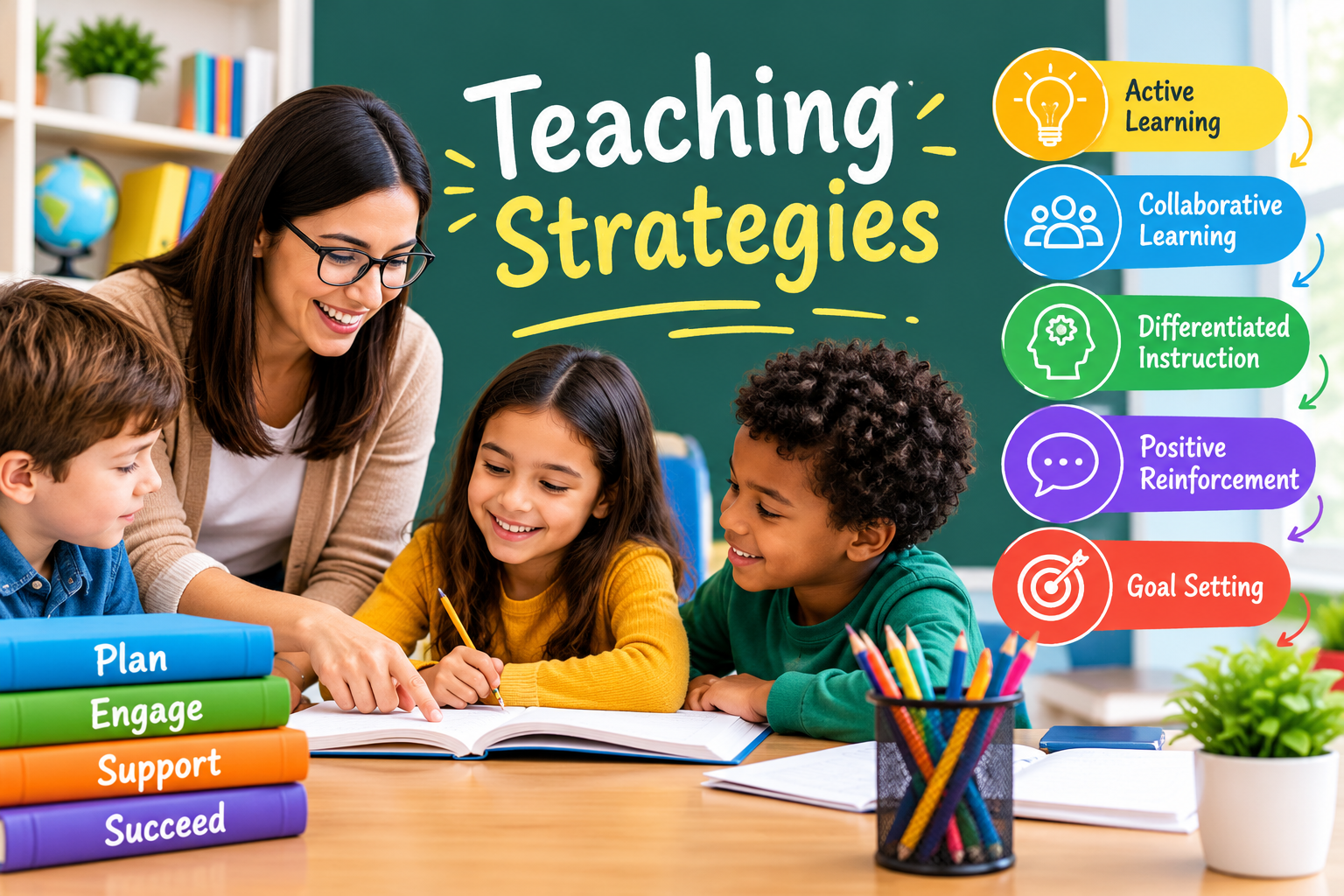
Teaching strategies are the methods, techniques, and approaches educators use to help students understand information, develop skills, participate in lessons, and become more confident learners. Effective teaching strategies are not limited to one classroom style. They can include direct instruction, group activities, questioning, demonstrations, problem-solving, technology-supported learning, and personalized support. The best approach depends on the subject, students’ needs, learning goals, classroom environment, and available resources.
Table of Contents
ToggleWhy Teaching Strategies Matter in Modern Education
Teaching strategies matter because students do not all learn in the same way or at the same pace. Some students may quickly understand an explanation, while others need an example, demonstration, discussion, or opportunity to practice before the concept becomes clear. A strong teaching strategy helps teachers turn complicated information into manageable learning experiences.
It can also increase participation, improve classroom communication, encourage critical thinking, and help students connect academic concepts with real situations. When teaching methods are selected intentionally, students are more likely to understand not only what they are learning but also why the knowledge matters.
Understanding Student-Centered Teaching
Student-centered teaching places learners at the heart of the educational process. Instead of making the teacher the only source of information, this approach gives students opportunities to ask questions, investigate ideas, discuss concepts, solve problems, and make decisions about their learning. The teacher still provides structure and guidance but acts more like a facilitator.
Student-centered classrooms can encourage independence because learners are expected to take an active role rather than simply listen and memorize. This strategy can be particularly useful when teachers want students to develop communication, creativity, collaboration, and problem-solving skills alongside subject knowledge.
Using Direct Instruction Effectively
Direct instruction remains an important teaching strategy, especially when students need clear explanations of new concepts. In this approach, the teacher introduces information in an organized way, explains important ideas, demonstrates processes, and provides opportunities for guided practice. Direct instruction becomes more effective when explanations are concise and supported by examples.
Instead of delivering a long lecture without interaction, teachers can pause to ask questions, check understanding, demonstrate an application, and allow students to practice the new skill. This combination gives students a clear foundation before they move toward independent work.
Learning Through Real-World Examples
Students often understand academic concepts more easily when they can see how those concepts apply outside the classroom. Real-world examples connect theoretical knowledge with practical situations. A mathematics teacher might use budgeting examples, while a science teacher could discuss everyday environmental problems.
Language lessons can involve authentic communication, and business classes can examine realistic company situations. This strategy makes lessons more relevant and helps students see the practical value of what they are learning. When learners understand the connection between a subject and real life, they may become more motivated to engage with the material.
Problem-Based Learning for Deeper Understanding
Problem-based learning begins with a meaningful problem rather than simply presenting all the information first. Students investigate the situation, identify what they need to know, consider possible solutions, and explain their conclusions. The teacher guides the process without immediately providing every answer.
This strategy can encourage critical thinking because students must decide how to approach an unfamiliar challenge. It can also help learners develop research, communication, reasoning, and decision-making skills. Problem-based learning works particularly well when the problem is appropriately challenging and connected to the learning objectives.
Project-Based Teaching Strategies
Project-based learning allows students to explore a topic over an extended period and produce something that demonstrates their understanding. Projects may involve research, writing, presentations, models, experiments, digital creations, or practical solutions. A well-designed project has a clear purpose, manageable stages, and criteria for evaluating the final result.
Teachers can divide a large project into smaller milestones, so students receive feedback throughout the process. This prevents the assignment from becoming overwhelming and allows learners to improve their work before completion. Projects can also make classroom learning more memorable because students actively create rather than only consume information.
The Role of Active Learning
Active learning requires students to do something with the information they receive. They may solve a problem, discuss an idea, organize information, explain a concept, conduct an experiment, or create a response. The purpose is to move beyond simple listening or memorization.
Active learning can make lessons more engaging because students continually interact with the material. Even short activities can make a difference. A teacher might stop during a lesson and ask students to explain a concept to a partner before continuing. These small moments give learners a chance to process information rather than simply hear it.
Technology as a Supporting Teaching Strategy
Digital technology can expand the range of teaching techniques available to educators. Interactive presentations, educational platforms, digital quizzes, simulations, videos, collaborative documents, and virtual resources can provide additional ways to explain and practice concepts. Technology should support the learning objective rather than become the objective itself.
A sophisticated tool is not automatically an effective teaching strategy. Teachers should consider whether the technology makes information clearer, provides useful practice, increases participation, or offers learning opportunities that would otherwise be difficult to achieve.
Using Visual Learning Materials
Visual materials can make complex information easier to organize and remember. Diagrams, timelines, charts, concept maps, illustrations, and carefully designed slides can help students see relationships between ideas. Visual resources are particularly helpful when a concept involves processes, structures, sequences, or comparisons.
However, too many visual elements can become distracting. Effective visual teaching uses simple and relevant materials that reinforce the central idea. Teachers can also ask students to create their own diagrams or concept maps, turning visual learning into an active task.
Formative Assessment During Lessons
Formative assessment allows teachers to check learning while instruction is still taking place. Short quizzes, exit questions, classroom discussions, quick written responses, polls, and observation can reveal whether students are following the lesson. The information gathered can then influence the next teaching decision.
If many students misunderstand a concept, the teacher can revisit it using another explanation or example. If students demonstrate strong understanding, the teacher can move toward a more challenging task. Formative assessment is therefore not simply about giving grades; it is about improving instruction and learning in real time.
Teaching Through Storytelling
Storytelling can make lessons more memorable by placing information within a meaningful context. Historical events, scientific discoveries, literary concepts, and even mathematical ideas can sometimes be introduced through stories or real situations. A good educational story should support the learning objective rather than distract from it.
Teachers can use short narratives to introduce a topic, illustrate a difficult concept, or show how an idea developed over time. Students can also create their own stories to demonstrate understanding, turning storytelling into an assessment activity.
The Future of Teaching Strategies
The future of education will likely involve an increasingly flexible mix of traditional instruction, collaborative learning, digital resources, personalized support, and practical problem-solving. Technology and artificial intelligence may give teachers additional tools to create resources and support different learning needs, but human guidance remains important.
Teachers understand classroom relationships, motivation, context, and individual student behavior in ways that technology cannot fully replace. Future-ready teaching will therefore focus not simply on using new tools but on using them purposefully to strengthen learning.
Final Thoughts on Effective Teaching Strategies
Teaching strategies provide educators with practical ways to make learning clearer, more active, and more meaningful. From direct instruction and questioning to collaborative learning, differentiated teaching, projects, feedback, and independent study, each approach has a valuable role when used for the right purpose. The most effective teaching does not depend on following one rigid formula.
It comes from understanding learners, setting clear objectives, choosing suitable methods, checking progress, and adapting instruction when necessary. By combining thoughtful planning with flexibility, teachers can create learning experiences that encourage knowledge, confidence, curiosity, critical thinking, and long-term growth.
FAQs
What are teaching strategies?
Teaching strategies are planned methods and techniques teachers use to help students understand information, develop skills, participate actively, and achieve learning objectives.
Why are teaching strategies important?
Teaching strategies are important because students have different learning needs, abilities, and levels of prior knowledge.
What is the most effective teaching strategy?
Effective teachers usually combine approaches such as direct instruction, questioning, collaborative learning, demonstrations, problem-solving, practice, and feedback according to the lesson objective.
What is student-centered teaching?
Instead of only listening to the teacher, students discuss ideas, solve problems, ask questions, conduct activities, and take greater responsibility for their learning.
How does collaborative learning help students?
Collaborative learning allows students to work together, exchange ideas, explain concepts, and solve problems.
Also Read Here: Snapjotz com

1 thought on “Teaching Strategies for More Engaging and Productive Classrooms”